



Hash Hedge — A Crypto Prop Firm: Review, Trader Reviews, and How-To Guide

The crypto market keeps expanding, but most traders run into the same wall: not enough starting capital to actually execute their strategies and scale up profit. Risking your own money is nerve-wracking, and not everyone has a serious sum sitting around for full-scale trading. That’s exactly where prop trading comes in — a model that already upended traditional financial markets and is now actively taking over crypto.
In this article, we take a close look at Hash Hedge — one of the leading prop trading firms specializing exclusively in crypto, offering traders access to up to $200,000 in capital with zero risk to their own money. We’ll break down how the platform works, what terms it offers, and whether prop trading is genuinely a real shot at earning money without putting your own capital on the line.
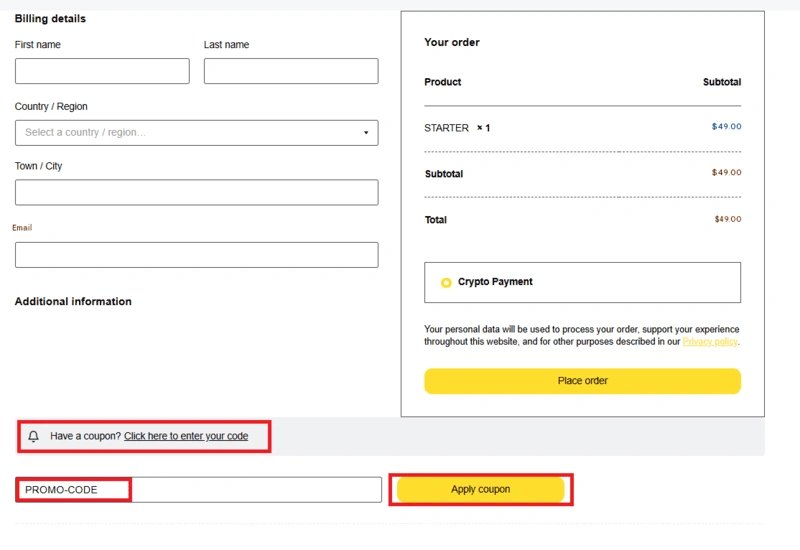
 20% off promo code. Use code RANK20 to get 20% off your first challenge at Hash Hedge. The code is valid only when you sign up for a new account through our link.

Hash Hedge positions itself as a next-generation platform with access to more than 160 crypto assets, including Bitcoin, Ethereum, Solana, and a wide range of other altcoins, plus U.S. stocks, RWAs, and TradFi assets — gold, silver, platinum, palladium, Brent and WTI crude, natural gas, and the S&P 500 index — all traded against USDT. Unlike most competitors, which impose strict limits on trading through news events or ban high-volatility strategies, Hash Hedge gives traders full freedom: no hidden fees, and the ability to use scalping, HFT bots, arbitrage, and leverage up to 1:5.
The company has been operating since 2023, and over that time has paid out more than $12.5 million to traders and served over 5,120 people. The PropTradingRank.com editorial team dug into how this prop firm actually operates — from its founding story to real user reviews — examining every stage of getting funded, the platform’s feature set, and its current pricing.

- What Is Prop Trading? Why Is It Trending?
- The History of Hash Hedge
- Hash Hedge Platform Overview
- Hash Hedge Features and Capabilities
- Trading Instruments and Assets
- Automation and Bots
- Trading Through News and Volatility
- Payouts and Withdrawals
- Analytics Tools and Interface
- Education and Support
- How to Get Funded?
- Tips for Clearing the Challenge
- Hash Hedge Reviews — What Do Real Traders Say?
- Real Reviews
- An Objective Look at the Reviews.
- Growth Prospects
- Conclusion
What Is Prop Trading? Why Is It Trending?
Prop trading is a trading model where you trade with a specialized firm’s capital instead of your own money. The term comes from “proprietary trading.” The idea is simple: you bring the skill and market read, the firm brings the capital and infrastructure. You trade the firm’s money, keep a percentage of the profit (typically 50% to 90%), and the firm keeps the rest. Your own money stays out of harm’s way the whole time — the prop firm carries the risk, not your wallet.

The mechanics are pretty transparent: the firm gives the trader access to markets, trading platforms, analytics tools, and — most importantly — capital to trade with. The trader goes through an evaluation period (the “challenge”), where they need to prove profitability under a set of rules — hitting a profit target without breaching a loss limit. Clear it, and you get a real account to manage, backed by virtual capital ranging from a few thousand to hundreds of thousands of dollars. All trades happen on demo accounts, but payouts come out of the company’s actual profit, in real money.
Where did prop trading come from in the first place? The model took shape in the US decades ago and grew inside banks and financial firms trading their own money rather than client funds. After the 2008 crisis and the Volcker Rule, U.S. banks were forced to drop risky speculative trading or spin it off into separate entities. That’s when the boom of independent prop trading firms began — recruiting talented traders, giving them capital, and splitting the profit. Prop firms traditionally worked with stocks, futures, and Forex, but in recent years the model has moved into crypto in a big way.
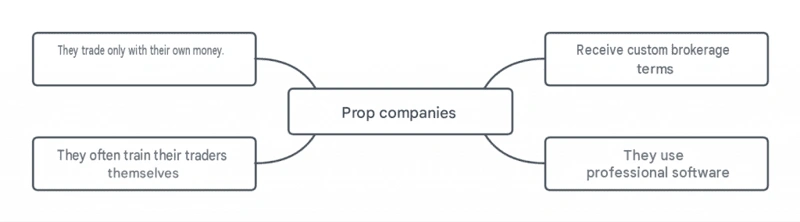
Why is prop trading trending right now, especially in crypto? The answer’s simple: the entry bar for serious crypto trading is high. To make real money off Bitcoin or altcoin volatility, you need decent capital — at minimum a few thousand dollars, ideally tens of thousands. Most beginners, and even a lot of experienced traders, don’t have that kind of money, or aren’t willing to risk it on an unstable market. Prop firms solve that problem: pay a small entry fee for the evaluation (typically $50 to $500 depending on account size), clear the challenge, and get access to $10,000, $50,000, or even $100,000 in capital. That opens up a completely different scale of earning potential, without risking your own savings.
Another reason for the explosive growth: strategy freedom. Unlike classic brokers with tight restrictions, many prop firms allow scalping, high-frequency trading, arbitrage, news trading, and even bots. That’s especially relevant for crypto traders, who love working with volatility and fast price moves. Crypto prop trading also draws people in with its sheer asset range — 160–200+ coins and tokens on a single platform, from mainstream Bitcoin and Ethereum down to exotic altcoins. You can diversify strategies, catch moves across different pairs, and scale profit in a way that’s hard to pull off with a small personal deposit.
The History of Hash Hedge
Hash Hedge made history as the first full-fledged crypto prop trading firm, founded in 2023. The platform launched at a unique moment: after the 2022 crypto winter, the market was beginning to recover, and interest in alternative ways to earn from digital assets spiked sharply. Hash Hedge’s founders noticed that prop trading, which had dominated traditional financial markets for decades, was virtually absent from the crypto space. Most existing prop firms worked exclusively with Forex, stocks, and futures, ignoring the huge potential of a crypto market defined by round-the-clock trading, high volatility, and a constantly growing list of assets.

The idea behind Hash Hedge grew out of a core problem in the crypto market: most talented traders simply don’t have enough capital to execute their strategies. Unlike traditional markets, where you can start small, crypto demands serious capital to generate meaningful profit given the high volatility and fees involved. The founders decided to replicate the successful classic prop firm model and adapt it to crypto’s specifics: give traders virtual capital, full freedom in choosing their strategies, and pay out the lion’s share of the profit — up to 90%.
Since launch, Hash Hedge has come a long way. The company started with a basic asset lineup but quickly expanded its listings to more than 160 cryptocurrencies, including every major coin and a range of promising altcoins. From the start, the platform positioned itself as an industry disruptor, stripping away the hidden restrictions and fees that plagued competitors. The team bet on maximum trader freedom: allowing scalping, high-frequency trading, arbitrage, news trading, and trading bots. Leverage up to 100x (later reduced to 5x for safety) opened the door to aggressive strategies on a volatile crypto market.

Over two years in business, Hash Hedge has paid out more than $12.5 million in profit to its traders and served over 5,120 active users worldwide. The company regularly adds new crypto assets as they appear on top-tier exchanges like Binance and Bybit. The platform offers seven pricing plans — from Starter at $79 with access to $5,000 in virtual capital, up to APEX at $1,393 with $200,000 in capital. That flexibility in account size has let Hash Hedge attract both beginners looking to try prop trading with minimal upfront cost, and experienced pros ready to work with large sums right away.
Hash Hedge actively engages with the crypto community, running tournaments and competitions for traders and partnering with educational projects. In 2025, the company launched a joint tournament with the platform Walbi, signaling its ambition to expand the ecosystem. It’s worth noting that Hash Hedge was originally registered in the UK in November 2022, though its legal structure was later reorganized. The platform’s mission has stayed consistent since day one: free traders from the restrictions holding back their potential, and give them access to capital with zero risk to their own money.
Hash Hedge Platform Overview
Hash Hedge is a specialized crypto prop trading platform giving traders access to virtual capital ranging from $5,000 to $200,000. The company is registered in Dubai and Ras Al Khaimah (UAE), underlining its base in a crypto-friendly jurisdiction. The platform provides access to more than 200 crypto assets, including major coins like Bitcoin, Ethereum, and Solana, as well as promising altcoins, memecoins, and DeFi tokens. What sets Hash Hedge apart is a complete absence of style restrictions: scalping, high-frequency trading, arbitrage, and trading through news and weekends are all allowed — critical for a crypto market that never sleeps.

The platform runs on a challenge model — a multi-stage evaluation period where the trader proves their profitability and risk-management discipline. Hash Hedge offers several pricing plans, each differing in virtual capital size, entry cost, and evaluation terms. Every trade during the challenge phases happens on demo accounts integrated with real exchanges like Binance and Bybit, guaranteeing identical market conditions. After clearing every stage, the trader gets access to a funded account and can earn up to 90% of net profit, paid out twice a month in crypto like USDT or USDC.
Key platform features include leverage up to 100x (capped at 1:5 on some accounts for safety), no hidden fees, and fast order execution thanks to integration with top exchanges. Hash Hedge regularly updates its asset listing, adding new coins as they hit top-tier exchanges. The platform runs on an intuitive interface with TradingView charting, automated challenge-rule verification within 24 hours, and round-the-clock technical support.
Hash Hedge Pricing Plans:
| Plan | Entry fee | Virtual capital | Phase 1 profit target | Phase 2 profit target | Max daily drawdown | Max overall drawdown | Trader profit split |
|---|---|---|---|---|---|---|---|
| Starter | $79 | $5,000 | 8% ($400) | 6% ($300) | 5% ($250) | 8% ($400) | 80% |
| Boost | $99 | $10,000 | 8% ($800) | 6% ($600) | 5% ($500) | 8% ($800) | 80% |
| Pro | $299 | $25,000 | 8% ($2,000) | 6% ($1,500) | 5% ($1,250) | 8% ($2,000) | 80% |
| Elite | $449 | $50,000 | 8% ($4,000) | 6% ($3,000) | 5% ($2,500) | 8% ($4,000) | 80% |
| Legend | $799 | $100,000 | 8% ($8,000) | 6% ($6,000) | 5% ($5,000) | 8% ($8,000) | 80% |
| Titan | $1,093 | $150,000 | 8% ($12,000) | 6% ($9,000) | 5% ($7,500) | 8% ($12,000) | 80% |
| APEX | $1,393 | $200,000 | 8% ($16,000) | 6% ($12,000) | 5% ($10,000) | 8% ($16,000) | 80% |
The challenge entry fee isn’t refundable, but it buys access to managing a much larger sum of capital. For instance, paying $99 for the Boost plan gives a trader the ability to trade with $10,000 — a completely different scale of earning potential. Every plan requires clearing two evaluation phases: an 8% profit target in phase one, and 6% in phase two, relative to the virtual deposit. An important detail: in phase two, the maximum overall drawdown tightens from 10% down to 8%, which demands tighter risk control.

After clearing the challenge, a trader moves to the third stage — live trading with Hash Hedge’s own capital. The same rules from phase two apply here: a maximum daily loss of 5%, and an overall drawdown cap of 8%. Breaching either limit triggers an automatic account closure, but the trader can buy a new challenge and try again. The minimum number of trading days required to clear each phase is typically 5, ruling out lucky one-off profitability and proving a systematic approachд.
Hash Hedge Features and Capabilities
Hash Hedge gives traders an impressive set of features and tools that set the platform apart from prop trading competitors. Its headline feature is total freedom of trading strategy, with no artificial restrictions. Unlike many prop firms that ban high-frequency trading, scalping, or news trading, Hash Hedge allows absolutely everything — from lightning-fast scalping on one-minute charts to trading bots and arbitrage strategies. That matters a lot in crypto, where volatility can spike within seconds and a trader needs maximum flexibility to capitalize on it.
Trading Instruments and Assets
The platform gives access to more than 200 cryptocurrencies, including every major coin — Bitcoin, Ethereum, Solana, XRP, Cardano, Polygon, Avalanche, and dozens more. The listing keeps growing: as soon as a new coin lands on a top-tier exchange like Binance or Bybit, it’s automatically added to Hash Hedge. That opens the door to portfolio diversification, trading memecoins during hype cycles, working with DeFi tokens, and hunting for alpha in lesser-known altcoins. A trader can hold positions across multiple pairs simultaneously, hedge risk, and exploit correlations between assets to build more sophisticated strategies.
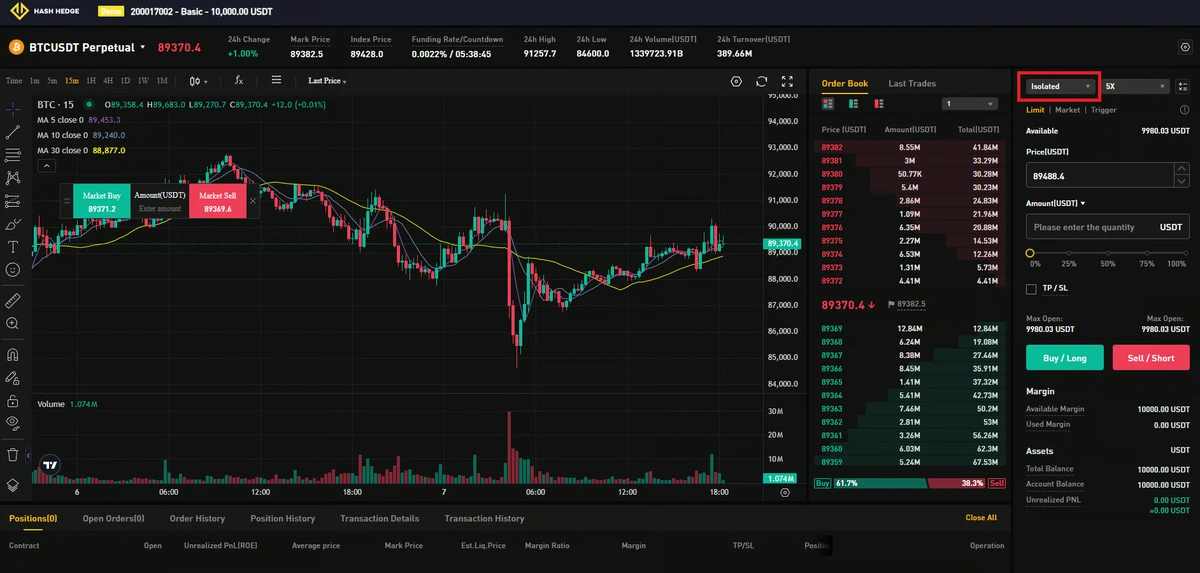
Leverage runs up to 100x on some accounts, though it’s capped at 1:5 on many plans for safety. High leverage is a double-edged sword: it can significantly amplify profit from small price moves, but it can also trigger instant liquidation if risk management goes wrong. Hash Hedge doesn’t tack on extra fees for using leverage, which makes aggressive strategies more cost-effective than on classic exchanges. Importantly, every trade during the challenge phases runs on demo accounts integrated with real exchanges via API, ensuring identical order execution and spreads.
Automation and Bots
Hash Hedge fully permits the use of trading bots — rare among prop firms. Traders can connect popular bots like Gunbot, 3Commas, and Cryptohopper, or run their own scripts through the API. That opens the door to high-frequency trading (HFT), market making, cross-exchange arbitrage, and automated scalping. Bots run around the clock, executing hundreds of trades a day with no emotion and no fatigue — critical for a crypto market that never sleeps. Automation strategies include indicator-based trading, grid trading, DCA (dollar-cost averaging) strategies, and liquidity provision on low-volume pairs.

The platform doesn’t cap the number of trades per day, letting scalpers and HFT bots run at full throttle. Some traders execute dozens or even hundreds of trades daily, catching tiny price moves and stacking up small profits that add up to substantial results. It’s worth understanding that using bots requires a solid grasp of the market and correct risk-parameter configuration — a poorly configured bot can blow an account fast, especially at high leverage.
Trading Through News and Volatility
One of Hash Hedge’s main advantages: no ban on trading through news and macroeconomic events. Many prop firms block trading ahead of major data releases (inflation reports, Fed decisions, major crypto industry events), worried about sharp moves and slippage. Hash Hedge takes a different approach: the trader decides for themselves whether to trade the news or steer clear of it. That opens the door to profiting from sharp volatility spikes, which often follow SEC announcements, new coin listings on major exchanges, or DeFi protocol hacks.
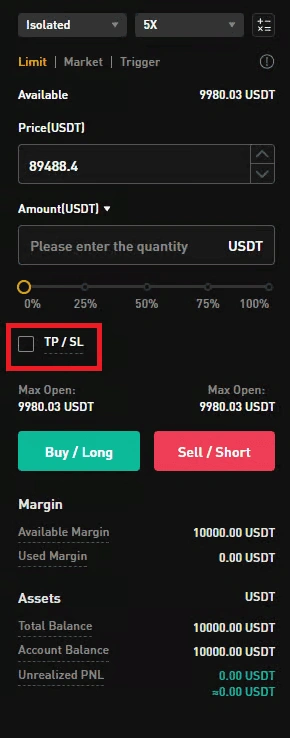
Round-the-clock, seven-day-a-week trading is another plus for crypto traders. Unlike traditional markets with weekends and holidays, crypto runs 24/7, and Hash Hedge places no restrictions on weekend or overnight trading. That lets traders catch moves during the Asian session, when European and American traders are asleep, or trade Sunday, when liquidity thins out and volatility picks up.
Payouts and Withdrawals
Hash Hedge offers one of the most generous profit-split models in the market: traders keep up to 90% of what they earn, with the company taking just 10%. Payouts happen every two weeks, once the trader has met the minimum trading period and accumulated enough profit to withdraw. The first withdrawal is available after 14 days of active trading on the live account — a safeguard against random profitability that also motivates the trader to trade systematically.
The withdrawal process is about as simple as it gets: the trader submits a request in their dashboard, specifies an amount (within the 14-day limit), and provides a wallet address for the crypto payout. Payouts come in USDT, USDC, or other cryptocurrencies of choice. Many traders point to the processing speed — funds often arrive within hours, sometimes even minutes, of approval. The withdrawal limit scales with account size: on a $10,000 account, for example, the limit is $10,000 per 14 days, which is more than enough for most traders.
Analytics Tools and Interface
The Hash Hedge platform is integrated with TradingView — one of the most popular technical-analysis systems among traders. That gives access to hundreds of indicators, charting tools, the ability to build custom strategies in Pine Script, and to copy ideas from other traders. The interface is intuitive and adapted for both web and mobile, letting you trade from any device. Every trade, account balance, current drawdown, and profitability stat is displayed in real time, which helps you keep risk in check and stay within the challenge rules.
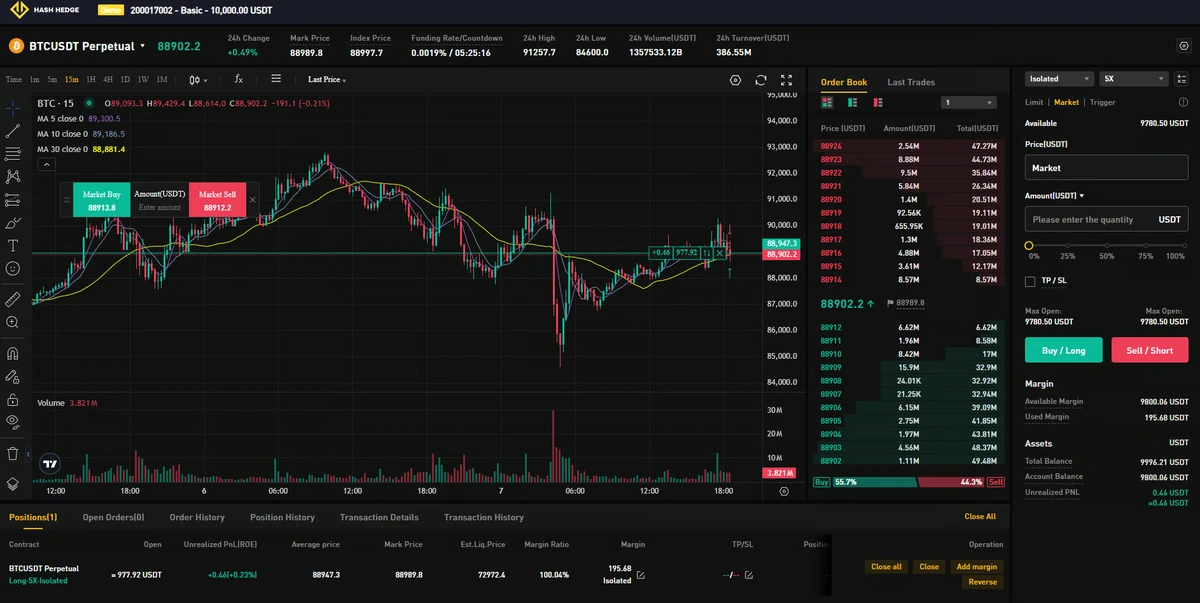
The system automatically tracks drawdown compliance: if the daily loss exceeds 5% or the overall drawdown hits 8–10% (depending on the phase), trading is locked and the account closes. It’s a strict rule, but it protects both the trader — from emotional revenge trading — and the company, from catastrophic losses. Automated challenge verification happens within 24 hours: if the targets are met, the trader advances to the next phase or gets access to a live account.
Education and Support
Hash Hedge provides educational material for beginners: articles on prop trading, risk-management strategies, market breakdowns, and tips for clearing a challenge. Technical support runs 24/7 and responds via live chat, email, and social media. Many traders point to the support team’s responsiveness and willingness to help resolve technical issues. The platform is also active on social media, publishing market reviews, trader success stories, and announcements of new features.

Hash Hedge’s affiliate program lets you earn up to 80% of the cost of challenges purchased by referred traders. That’s an appealing option for content creators, educational projects, and experienced traders looking to scale income beyond trading through referrals as well. Affiliate payouts come in crypto and process just as fast as trading profit.
How to Get Funded?
Getting virtual capital on Hash Hedge is a staged process built around clearing a challenge, which functions as the trader’s exam. The goal of the challenge is straightforward: prove to the firm you can trade consistently, control risk, and not blow the deposit on emotion. A prop firm can’t just hand out money to anyone who asks — it needs confidence that a trader is trading systematically, not relying on luck. The challenge consists of two mandatory phases with clear profit targets and strict loss limits, breaching which instantly ends the attempt. Clear both, and you move to the third stage — live trading with the company’s capital, with the ability to withdraw up to 90% of the profit.
Step-by-step guide to getting funded:
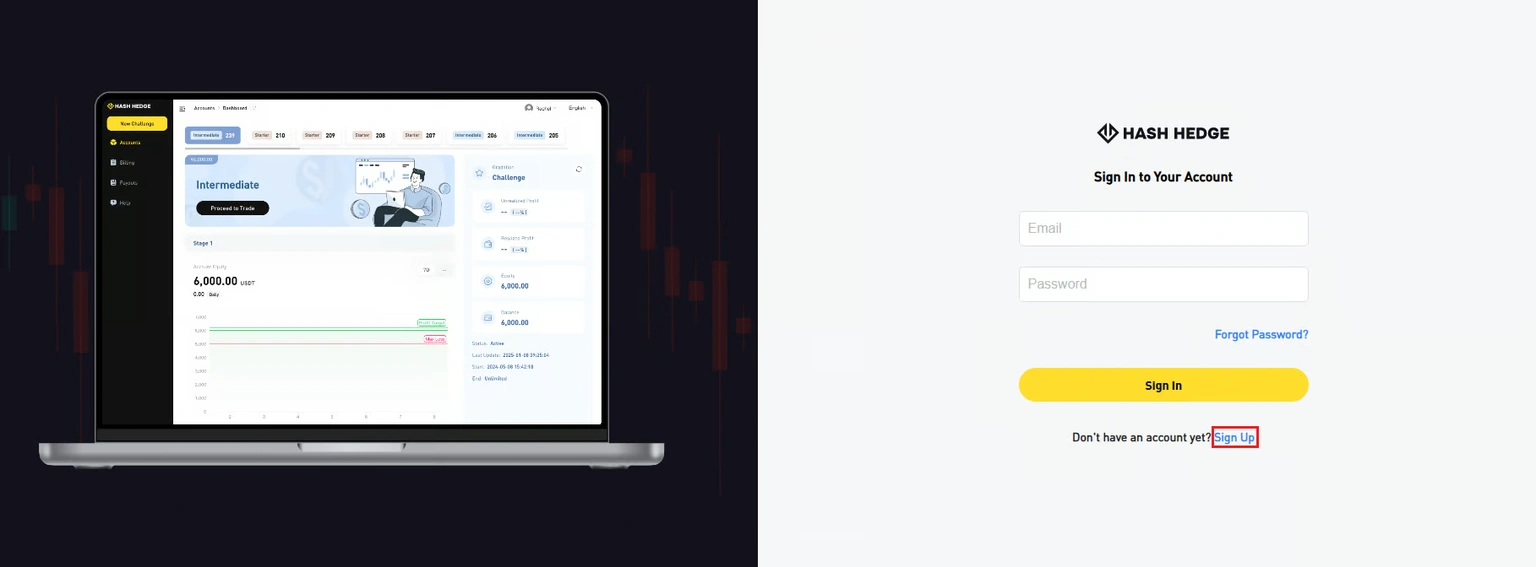
Step 1. Sign up on the Hash Hedge platform.
The process starts with creating an account on the official Hash Hedge site. Registration is as simple as it gets: provide an email, set a password, and confirm your account through the verification email. From there, you land in your dashboard, where you can pick a suitable pricing plan and review the challenge rules. No additional verification like passports or selfies is required to get started — you can jump straight in.
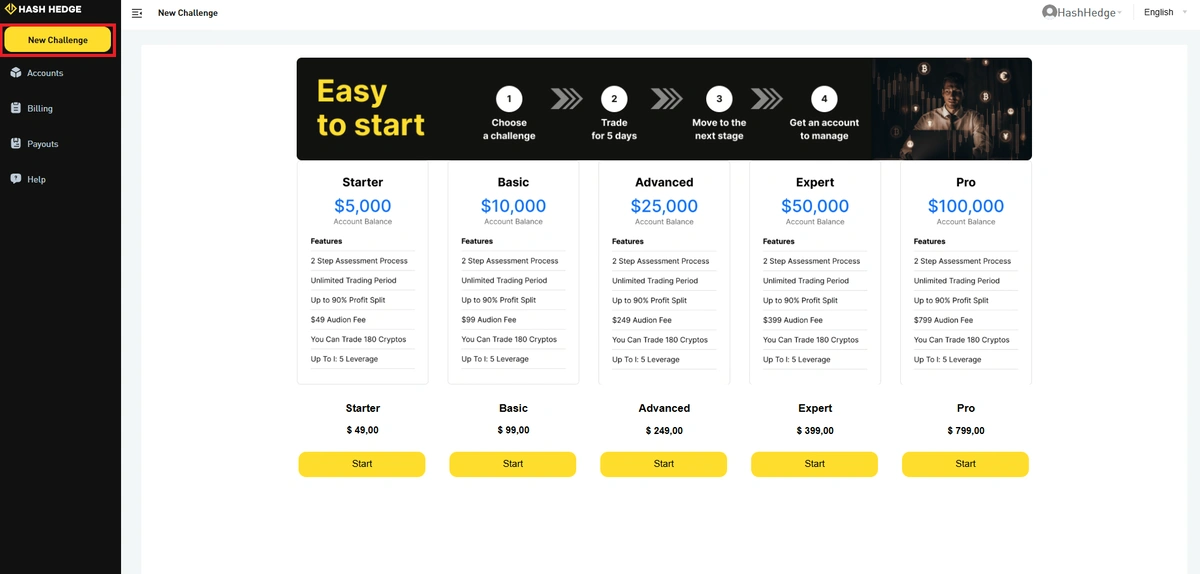
Step 2. Choose a pricing plan and pay.
Hash Hedge offers seven challenge options: Starter at $79 with $5,000 in capital, Boost at $99 with $10,000, Pro at $299 with $25,000, Elite at $449 with $50,000, Legend at $799 with $100,000, Titan at $1,093 with $150,000, and the recently added APEX at $1,393 with $200,000. Pick based on your experience and budget — beginners are better off starting small, to get comfortable with the rules without risking a large sum right away. Payment is accepted exclusively in crypto through a payment gateway — you send USDT (or another specified coin) to the wallet address the system generates. Double-check the transfer network (usually Tron TRC-20 or Ethereum ERC-20), or the funds will be lost.
Step 3. Challenge activation and access to the trading terminal.
Once payment is confirmed, the system automatically activates the challenge, and you get access to the trading terminal. The interface closely resembles standard crypto exchanges like Binance or Bybit — charts, an order book, an order-entry panel, and a list of available pairs. The dashboard displays all current-phase info: balance, profit target, current drawdown, days traded, and remaining loss limits. The platform is integrated with TradingView, giving access to professional technical-analysis tools.
Step 4. Clear the first phase of the challenge.
In phase one, your job is to earn 8% of the starting balance without exceeding a 5% daily drawdown or a 10% overall drawdown. For example, on the Starter plan ($5,000), you need to make $400 in profit, while your daily loss can’t exceed $250, and your overall loss can’t exceed $500. A mandatory condition: trade a minimum of 5 trading days, even if you hit the profit target in a single day. This rule protects against lucky one-off profitability and forces systematic trading. There’s no time limit on the phase — you can take a week, a month, or longer, as long as you don’t breach the loss limits.
Step 5. Clear the second phase of the challenge.
Phase two is slightly easier: the profit target drops to 6%, but the maximum overall drawdown tightens from 10% to 8%. On that same Starter plan, you’d need to earn $300 in profit with a maximum loss of $400 over the whole period and $250 per day. The minimum trading-days requirement stays the same — 5 days. Phase two exists to confirm consistency: maybe phase one was luck, and phase two would blow it all. Challenge results are verified automatically within 24 hours of hitting the target. If the conditions are met, the system automatically moves you to phase three — the live account.
Step 6. Get your funded account and start earning.
After clearing both challenge phases, you get access to a funded account with virtual capital, where you can trade and withdraw real money. The rules on the third stage match phase two: a maximum daily drawdown of 5%, and an overall drawdown of 8%. Breaching either limit closes the account, but you can buy a new challenge and start over. Payouts are available every 14 days after the minimum trading period, and you keep 80% to 90% of the profit you earn. Money is withdrawn in crypto (USDT, USDC, and others), and many traders receive payouts within hours of requesting them.

Key challenge rules:
- Phase 1 profit target: 8% of the account balance (e.g., $400 on a $5,000 account).
- Phase 2 profit target: 6% of the account balance (e.g., $300 on a $5,000 account).
- Maximum daily drawdown: 5% of the starting balance at every stage (e.g., $250 on a $5,000 account).
- Maximum overall drawdown in phase 1: 10% of the balance (e.g., $500 on a $5,000 account).
- Maximum overall drawdown in phases 2 and 3: 8% of the balance (e.g., $400 on a $5,000 account).
- Minimum number of trading days: 5 days per phase, regardless of how fast you hit the target.
- Trading period: unlimited — take as long as you need on a phase, as long as you don’t breach the loss limits.
- Leverage: up to 1:5 on most accounts, with access to isolated and cross margin.
- Results verification: automatic, within 24 hours of hitting the profit target and minimum trading days
Tips for Clearing the Challenge
Hash Hedge isn’t a casino, and your approach needs to be professional. Rule one: control your risk on every single trade — risk no more than 0.5–1% of your deposit. On a $5,000 account, that’s $25–50 per trade, even if you’re 100% sure of the outcome. Rule two: don’t spiral after losing trades — three stop-outs in a row is only a 1.5% dent in your capital, and that’s completely normal. Trying to win it back, oversizing your risk, or trading on emotion is a guaranteed way to blow the account. Rule three: trade only within a system, with a clear plan for every trade — there’s no point trading without a strategy. Rule four: remember the money is virtual, which makes it psychologically easier, but treat it like it’s your own — you’re responsible for every decision.

Hash Hedge Reviews — What Do Real Traders Say?
Reviews of Hash Hedge fall into a rare pattern: opinions split into two clear camps — enthusiastic traders successfully withdrawing profit and praising the platform, and skeptics who think the challenge requirements are set too high. This kind of polarized opinion is typical for prop trading, especially in crypto, where high risk sits right next to fast earning potential. It’s worth keeping in mind that online reviews are a subjective tool — successful traders share their payouts, and unsuccessful ones tend to blame the platform for their own mistakes. Let’s break down what Hash Hedge users are actually saying on independent platforms, and which patterns show up most often.
Real Reviews
On the international aggregator Myfxbook, Hash Hedge has collected mostly positive ratings from traders who successfully cleared the challenge and received payouts. One user described buying a $25,000 challenge for $299, clearing phase one with an 8% profit target, and currently sitting in phase two. The trader specifically praised the trading terminal’s quality: TradingView charting, an order book, plenty of analysis tools, and a wide range of tradable crypto assets. Their one wish was to see leverage raised from 5x to 30x for more aggressive strategies.
Another success story comes from crypto scalpers who found Hash Hedge an ideal fit for their strategies. One user emphasized that the platform not only allows scalping but sets up great conditions for it: fast order execution, a wide coin selection, and a trading terminal that feels a lot like Binance. No adjustment period for the interface and low fees make Hash Hedge appealing to traders used to classic exchanges. The trader noted that payouts arrive within hours, with no unnecessary friction — which matters a lot for building trust in a prop firm.
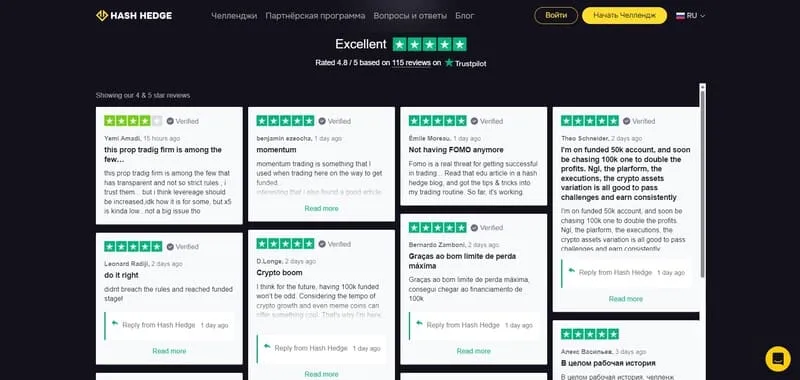
On Trustpilot, Hash Hedge holds a strong 4.8-out-of-5 rating based on 115 reviews, a very good score for a prop trading firm. Most comments are positive: traders praise the service, fast payouts, breadth of crypto assets, and responsive support. Many users report that after clearing the challenge and receiving their first payout, they started viewing Hash Hedge as a reliable partner. One trader wrote that the atmosphere on the platform makes for calmer trading, compared to other prop firms where pressure and mistrust are constant undercurrents.
An Objective Look at the Reviews.
Looking at the bulk of reviews, the occasional negative comments tend to stem not from a specific trading experience, but from general concerns about the project’s regulation and anonymity. Many critics aren’t actual Hash Hedge clients — they’re writing based on a surface-level look at the website. On the other hand, positive reviews come from people who genuinely cleared the challenge, traded on the platform, and received payouts. That doesn’t mean Hash Hedge is flawless, but it does suggest the company follows through on its commitments to successful traders.
It’s important to understand that prop trading isn’t free money, and most people fail the challenge due to a lack of discipline, poor risk management, or emotional trading. Traders who fail often blame the platform for their own losses, even though the real cause is their own mistakes. Hash Hedge is upfront about the risks and clearly lays out the challenge rules, and breaching them leads to account closure. That’s not a scam — it’s standard practice across prop firms worldwide.
Growth Prospects
Hash Hedge’s outlook looks strong against a backdrop of growing demand for crypto prop trading and the active integration of AI tools into trading workflows — conditions that set up the product and its audience for further growth. The market is signaling demand for fast access to capital, round-the-clock trading, and automated decision-making, and companies like Hash Hedge have already carved out a niche where fast updates, community engagement, and technological flexibility matter most.
The short-term direction is strengthening the product lineup by expanding the crypto asset list and quickly adding new market listings, which improves strategy diversification and reduces dependence on any single coin. Public initiatives at the level of the World Series of Crypto Trading (WSCT) boost brand recognition, help attract professional and algorithmic traders, and build a talent pipeline for funded accounts.

A key driver heading into 2026 is synergy with the AI ecosystem: the “human versus AI” format within WSCT shows the company is betting on algorithmic trading and machine-learning tools, so it’s reasonable to expect continued AI-platform integrations and the development of AI-driven analytics. The broader market already shows a clear trend toward applying AI in prop trading for risk control, pattern recognition, and execution optimization — and cementing those practices in the Hash Hedge interface would strengthen its competitive position.
One area for building more trust is legal transparency and public reporting metrics, since some criticism targets the company’s structure and the verifiability of its payout and client data. That said, the presence of positive user reviews on aggregators, backed by confirmed fast payouts, forms a solid foundation of loyalty — one that could be reinforced with regular reports and audits of key metrics.
The bet on community and education looks well-placed: launching educational content and actively running a blog helps onboard traders, reduces challenge failure rates, and improves risk discipline across the ecosystem. Expanding the lineup of tournaments and offline events creates multiple entry points for traders at different levels and keeps steady media buzz around the brand.
What might come next:
- More partner tournaments and offline events with an AI component, building on WSCT, to scale the funnel and attract algorithmic teams.
- Faster listing expansion and quicker addition of “hot” assets from top exchange listings, to sustain volatility and alpha opportunities for strategies.
- Built-in AI-powered risk-management hints and trade-quality dashboards, reflecting the broader market trend toward “smart” assistants for prop traders.
- Stronger public reporting on payouts and metrics, addressing current criticism and boosting trust among institutional partners.
- Continued development of the educational ecosystem and community events, growing an in-house pool of traders and lowering the failure rate on challenges.
- A new mobile app for prop trading on the go is also already in development, and should soon let traders execute trades quickly from their phones.
In short, Hash Hedge has a clear growth trajectory at the intersection of AI and prop trading, and a strategic focus on legal transparency and regular public reporting could accelerate its scaling and reduce skepticism around the model, amplifying the impact of its tournament and educational activity.

Conclusion
Hash Hedge represents an innovative project in the prop trading industry, adapting the classic model of trading with a firm’s capital to fit the fast-moving crypto market. The platform shows a serious approach to the business: transparent challenge terms, access to more than 160 crypto assets, no artificial restrictions on trading style, and a generous profit-split model paying out up to 90% to the trader. For anyone with trading skill but not enough starting capital, Hash Hedge opens a genuine opportunity to scale strategies and earn on someone else’s money with zero risk to personal savings.
That said, it’s important to understand that prop trading isn’t easy money, and it isn’t a free handout. Most Hash Hedge challenge attempts fail precisely because of a lack of discipline, poor risk management, and emotional trading. The platform demands a systematic approach, clear rules for entering and exiting trades, drawdown control, and psychological resilience.
Overall, Hash Hedge holds a leading position among the best crypto prop firms of 2026 and is worth a look both for beginner traders looking to access capital and for experienced professionals seeking a platform with maximum freedom. The company’s growth prospects are tied to AI integration, an expanding asset listing, and strengthening its standing in the crypto community through education programs and partnerships. If you’re ready to trade systematically, follow the rules, and learn from your mistakes, Hash Hedge could be your gateway into professional crypto trading on institutional capital.
Frequently Asked Questions
Is it safe to trade through Hash Hedge?
Hash Hedge runs on a prop trading model where every trade during the challenge phases happens on demo accounts integrated with real exchanges like Binance and Bybit. That means the trader doesn't risk their own money while trading — the company absorbs any losses, not your personal capital. The only thing you put in upfront is the challenge entry fee, ranging from $79 to $1,393 depending on the plan. Hash Hedge has been operating since 2023, has paid traders more than $11 million, and holds positive reviews from real users successfully withdrawing profit. To minimize risk, it's a good idea to start with a smaller plan, test the platform in practice, and move up to pricier tiers only afterward.
How much can you earn on Hash Hedge?
Potential earnings on Hash Hedge depend on the size of your virtual capital, your trading skill, and your ability to stick to the risk-management rules. Traders keep 80% to 90% of net profit, with the company taking the rest. For example, if you trade a $10,000 account and earn $1,000 in profit over two weeks, your share would be $800–$900, depending on the plan's terms. Successful traders running aggressive strategies on larger accounts — $50,000 or $200,000 — can earn tens of thousands of dollars a month, especially during periods of high crypto market volatility. That said, most beginners fail the challenge due to a lack of discipline and poor risk management. Consistent earnings in prop trading require a systematic approach, a clear trading strategy, and the psychological resilience to avoid blowing the account after a few losing trades in a row. Some professionals report earning a million dollars over several years of prop trading, but that's the result of years of experience, ongoing learning, and iron discipline.
Can you use trading bots on the platform?
Yes — Hash Hedge fully permits trading bots and automated strategies, which sets the platform apart from many competitors. Traders can connect popular tools like Gunbot, 3Commas, and Cryptohopper, or write custom Python scripts integrated via API. That's especially appealing for anyone running high-frequency trading, cross-exchange arbitrage, or grid strategies that require executing hundreds of orders a day in an instant. It's important to configure your bot's risk parameters carefully, so you don't breach the daily and overall drawdown limits, which the system enforces strictly. A poorly configured bot can blow an account in minutes, especially with high leverage — so it's a good idea to thoroughly test your algorithms on a demo before running them on real capital. Automation opens up huge scaling potential, but it demands a solid grasp of programming, technical analysis, and market microstructure.
How long does the challenge take to complete?
There's no maximum time limit for clearing a Hash Hedge challenge — you can trade for a week, a month, or longer, until you hit the profit target. The one mandatory requirement is a minimum of 5 trading days per phase, even if you hit the target in a single day. This rule exists to rule out lucky one-off profitability and force traders to prove a systematic approach. Phase one requires earning 8% of the balance, and phase two requires 6%, all without exceeding a 5% daily drawdown and a 10% overall drawdown in phase one (8% in phase two). Some experienced traders clear both phases in 10–15 days by trading aggressively and confidently, while others need several weeks or months of cautious, low-risk trading. It's important not to rush or oversize your risk trying to clear the challenge faster — that's a surefire path to failure. It's better to take extra time and preserve the account, successfully moving on to the funded stage where you can start earning real money.
What should you do if you fail the challenge?
Failing a Hash Hedge challenge is a normal part of learning prop trading, and most traders don't pass on their first attempt. If you breach the drawdown limits or don't hit the profit target, the account closes, but you can buy a new challenge and try again, applying what you learned. Many successful traders went through several attempts before learning to control their emotions and stick to discipline. After a failure, it's important to analyze what went wrong: did you oversize your risk, trade against the trend, ignore your stops, or simply lack a clear trading plan? Hash Hedge provides detailed statistics on every trade, which helps pinpoint weak spots in your strategy. Some traders keep a trading journal, logging every trade, the reasoning behind entries and exits, and how they felt in the moment — a powerful tool for working through mistakes. If you fail the challenge several times in a row, it might be worth starting with a smaller account, like the $79 Starter plan, to sharpen your skills with smaller sums and less psychological pressure. The main thing is not to give up, and to treat every failure as a lesson on the way to consistent earnings in prop trading.
Trader Reviews
Related Articles:


















- What Is Prop Trading? Why Is It Trending?
- The History of Hash Hedge
- Hash Hedge Platform Overview
- Hash Hedge Features and Capabilities
- Trading Instruments and Assets
- Automation and Bots
- Trading Through News and Volatility
- Payouts and Withdrawals
- Analytics Tools and Interface
- Education and Support
- How to Get Funded?
- Tips for Clearing the Challenge
- Hash Hedge Reviews — What Do Real Traders Say?
- Real Reviews
- An Objective Look at the Reviews.
- Growth Prospects
- Conclusion

Top 10 Best Prop Firms
| # | Prop Firm | Rating | Assets | Profit Split | Funded Capital | Challenge Fee | Founded | Promo Code | Website |
|---|---|---|---|---|---|---|---|---|---|
|
1
|
4.9
|
Crypto, Stocks, Indices, Metals, Energy
|
Up to 90% | Up to $200,000 | From $79 | 2023 |
20% discount
RANK20
|
Visit Website | |
|
2
|
4.8
|
Crypto, Forex
|
Up to 90% | Up to $200,000 | From $99 | 2023 |
20% discount
RANK20
|
Visit Website | |
|
3
|
4.7
|
Prediction Markets, Polymarket
|
Up to 90% | Up to $50,000 | From $30 | 2026 |
25% discount
RANK25
|
Visit Website | |
|
4
|
4.7
|
Crypto, Forex, Other Assets
|
Up to 90% | Up to $200,000 | From $59 | 2024 |
10% discount
Follow the link
|
Visit Website | |
|
5
|
4.7
|
Crypto
|
Up to 90% | Up to $200,000 | From $59 | 2023 |
10% discount
Follow the link
|
Visit Website | |
|
6
|
4.6
|
Crypto, Forex, Stocks, Indices, Metals, Energy
|
80%–100% | Up to $200,000 | From $49 | 2026 |
30% discount
RANK30
|
Visit Website | |
|
7
|
4.6
|
Forex, Stocks, Indices, Metals
|
Up to 90% | Up to €300,000 | From €40 | 2023 |
30% discount
RANK30
|
Visit Website | |
|
8
|
4.5
|
Crypto, Forex, Indices, Metals
|
80%–100% | Up to $200,000 | From $89 | 2013 |
No Promo Code
|
Visit Website | |
|
9
|
4.5
|
Crypto, Forex
|
Up to 90% | Up to $200,000 | From €79 | 2015 |
No Promo Code
|
Visit Website | |
|
10
|
4.3
|
Crypto, Forex, Other Assets
|
60%–95% | Up to $200,000 | From $32 | 2024 |
20% discount
HELLO
|
Visit Website |