



Upscale Review — The First Web3 Prop Firm for Crypto Traders: Sign-Up, Features, Reviews, and Trading Guide

The crypto market keeps changing fast, and where a serious starting capital used to be a prerequisite for trading successfully, things look different today. The PropTradingRank.com editorial team ran a detailed analysis of Upscale — the world’s first Web3 prop trading platform, combining capital, blockchain technology, and a reward system for traders.
In this article, we break down exactly how this innovative platform works, why it markets itself as “next-generation prop trading,” and — most importantly — whether you can genuinely earn real money here trading crypto with the company’s capital instead of risking your own. We reviewed every challenge, the payout terms, the platform’s feature set, and gathered real feedback from traders who’ve already withdrawn their first profit. The numbers are worth noting: up to $200,000 in trading capital, 200+ trading pairs, a fee of just 0.008% (10–20 times lower than competitors), and full Telegram integration for instant access to trading.
 10% off promo code. We have a special promo code that gets you a 10% discount on any Upscale challenge purchase. To get the code, just go through the official Upscale Telegram bot and the discount activates automatically
If you’re tired of blowing your own deposits, afraid to risk large sums, or simply want to test your trading strategies without financial stress, this article is for you. We’ll cover how Upscale differs from classic prop firms, how sign-up works here (spoiler: it takes just a couple of minutes with no KYC), what pricing plans and challenge terms are available. We’ll dig into how to trade directly through the Telegram bot, which crypto assets are available for trading, and why the trading terms here are considered some of the most competitive in the prop trading industry. We’ll also cover the common mistakes beginners make in prop trading, the platform’s growth prospects built on Web3 technology, and, of course, share real user reviews from people who’ve already tried Upscale and gotten their first payouts. Ready to dive into next-generation prop trading? Let’s go!

Prop Trading and Web3 (Web 3.0), Explained
Let’s start with the basics so everyone’s on the same page. Prop trading (short for proprietary trading, or “prop”) means trading with the company’s capital instead of your own money. Sounds too good to be true, right? Picture this: you get, say, $50,000–$200,000, you trade crypto with it, and if you turn a profit, you keep 80–90% of what you earn. The company takes on the financial risk, and all you’re putting up is your time and a relatively small entry fee for the challenge (usually $50 to $500). That fundamentally changes the psychology of trading — there’s none of that gut-wrenching stress of watching your last dollars disappear from a personal deposit.
Classic prop trading dates back to Wall Street in the 1980s, when major banks and hedge funds started recruiting talented traders and letting them manage real capital. Today, that model has evolved into an online format: firms like FTMO, TopStep, or FundedNext have you clear an evaluation, prove your skill, and get access to a trading account. The catch is the rules are strict: maximum drawdown of 5–10%, a required profit percentage per month, no holding Forex positions over the weekend. But if you can meet the conditions, you get a stable income stream with zero risk of losing your own savings.
Now, about Web3. If Web 1.0 was the static brochure-style websites of the ’90s, and Web 2.0 was social media and interactive content, then Web 3.0 is a decentralized, blockchain-based internet. The key difference: in Web3, there’s no central server that can lock your account or freeze your funds. Everything runs on smart contracts — self-executing programs on the blockchain that enforce conditions with no intermediary. For example, a smart contract automatically credits your profit once you’ve met the challenge conditions — no bureaucracy, no payout delays, no “the manager’s out sick.”
Upscale combined these two concepts and built the world’s first Web3 prop firm. That means complete transparency: every transaction is recorded on the TON (The Open Network) blockchain, you can check the prop fund’s balance in real time, and payouts happen automatically in crypto — usually USDT or TON. No 5–7-day bank transfers, no document verification, no bureaucracy. Trading happens right inside Telegram through a dedicated bot — you just open the messenger, pick an asset, and set your stop-loss and take-profit. That’s about as convenient as it gets for a generation used to handling everything through a smartphone.

Upscale Platform Overview
Now, let’s get into the details of Upscale itself. This platform burst onto the prop trading scene in 2024 and immediately positioned itself as the first genuine Web3 project in the space. The founders are the Storm Trade team, who already had experience building decentralized exchanges on the TON blockchain. They took the best of traditional prop trading — proven challenge mechanics, risk management, profit splitting — and combined it with what blockchain can do. The result is a platform where you can trade crypto 24/7 with no days off, instant USDT payouts, and all of it through the Telegram app you already use.
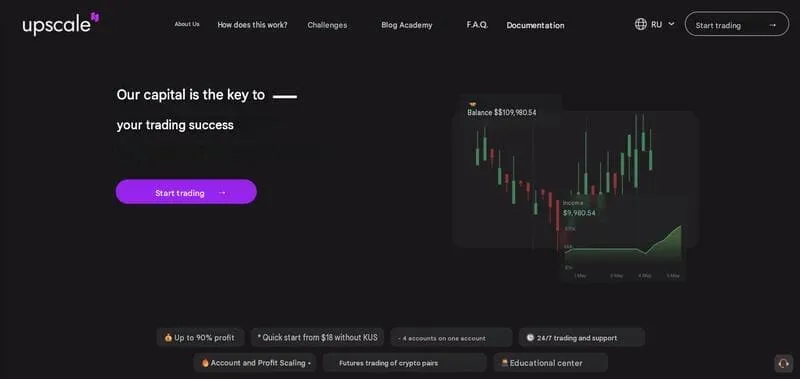
What immediately stands out is the low barrier to entry. Where classic prop firms charge $150–$200 minimum for a challenge, here you can start with a much smaller sum and test the system. There’s no identity verification (KYC) at all — registration takes literally 2 minutes: connect Telegram, pick a pricing plan, pay through your crypto wallet, and you’re trading. That’s a world apart from FTMO, where you fill out forms, wait for document review, and only then get access to a demo account.
Let’s look at the platform’s key characteristics compared against the broader market:
| Characteristic | Upscale | Comment |
|---|---|---|
| Platform type | Web3 prop trading | The first decentralized prop-company on the TON blockchain |
| Year of foundation | 2024 | A new project from the Storm Trade team |
| Maximum capital | $200,000 | Available after completing challenges |
| Trading instruments | 200+ cryptocurrency pairs | BTC, ETH, SOL, TON and altcoins |
| Transaction commission | 0.008% | 10-20 times lower than competitors |
| Profit sharing | Up to 90% for a trader | Depends on the plan you choose |
| Minimum deposit challenge | From $59 | One of the lowest on the market |
| KYC/verification | Not required | Anonymous trading via Telegram |
| Payment time | Instantly | Automatic payments via smart contracts |
| Payment currency | USDT, TON | Cryptocurrency to your wallet |
| Trading platform | Telegram Bot | Messenger integration for quick access |
| Leverage | Up to 100x | High leverage for experienced traders |
| Maximum drawdown | 5-10% | Depends on the challenge plan |
| Minimum profit for a pass | 8-15% | Must be completed within the challenge period |
| Blockchain | TON (The Open Network) | Telegram's Fast and Cheap Blockchain |
One standout feature of Upscale is flexible configuration. You choose the capital size you want (from $10,000 to $200,000), the profit target you’re comfortable hitting, and how much time you need for the challenge. A conservative trader, for example, might pick a plan with an +8% target over 60 days and a maximum drawdown of 10%, while an aggressive scalper might go with a +15% target over 30 days but a tighter 5% drawdown. That’s a much smarter setup than the one-size-fits-all rules older prop firms use.
Another advantage: trading happens on real capital immediately after you pay for the challenge. There’s no split between a “demo phase” and “verification” — you’re trading the prop fund’s money right away, and if you meet the conditions, you get paid. That said, your first withdrawals may carry limits (say, up to $5,000 at a time), which is standard practice to guard against fraud. For traders who show consistent profit over several months in a row, those limits get lifted entirely.

The platform runs around the clock with no technical downtime, since it’s built on decentralized infrastructure. Even if the Upscale team hit some kind of force majeure event, your funds stay safe — they’re held in a smart contract on the blockchain, and you can always withdraw your balance. That’s a fundamental difference from classic prop firms, where money sits in corporate accounts, and if the firm goes bankrupt, you can kiss your balance goodbye.
The Story Behind Upscale
Upscale’s story didn’t come out of nowhere — behind the project is the Storm Trade team, which had been building a decentralized derivatives exchange on the TON blockchain since 2023. They originally built a platform for leveraged futures and options trading, and quickly noticed something: crypto traders kept blowing their deposits due to high risk and emotional trading. Meanwhile, classic prop firms worked only with Forex and stocks, ignoring a crypto market that moves billions of dollars daily. That’s when the idea was born: what if you combined prop trading with crypto and Web3 technology?
Upscale officially launched in Q1 2024. The founders positioned the project as “the first decentralized prop firm in the world.” It was a bold move, since crypto prop trading was barely developed as a niche — every major player was focused on traditional markets. Upscale came out of the gate offering Bitcoin, Ethereum, Solana, and hundreds of other altcoins with capital up to $200,000. And all of it ran through a Telegram bot — no downloading MetaTrader, no complicated sign-ups, just open the messenger and trade.
A pivotal decision was choosing the TON (The Open Network) blockchain — the same one originally developed by Pavel Durov for Telegram before the project became independent. TON is a great fit for Upscale: transactions settle in 5 seconds, fees are negligible (under $0.01), and it has native Telegram integration. The Storm Trade team already had experience with this network, so they could quickly stand up the infrastructure and deploy smart contracts to automatically credit trader profit.

Upscale was also one of the first projects to drop KYC verification entirely. The founders explained this as a Web3 philosophy: everyone should have access to financial tools, regardless of where they live, their citizenship, or whether they have a bank account. That’s especially important for traders in countries with currency-operation restrictions or where opening an account with a Western broker is difficult. All you need is a crypto wallet and a Telegram account, and you’re trading the company’s capital.
As of late 2026, Upscale is actively building out its ecosystem: adding new features (copy-trading, social trading, automated bots), expanding the asset list, and launching educational programs for beginners. The team has stated its goal of going international and becoming a top-3 global prop firm by 2027. Ambitious? Absolutely. But given the pace of growth in the crypto market and interest in Web3 technology, they have a real shot at pulling it off.
How Upscale Stands Apart from Competitors
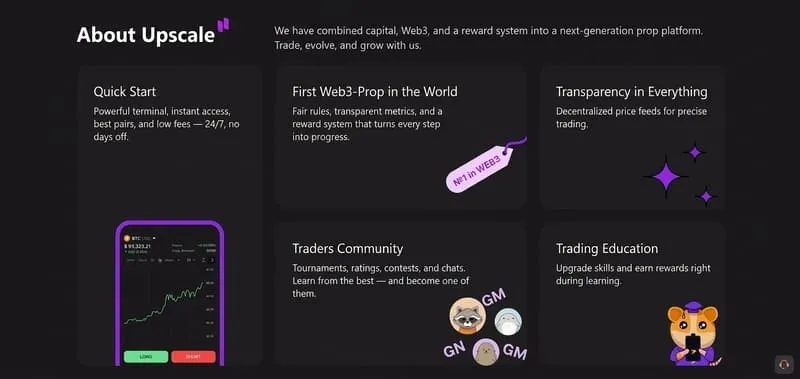
Upscale sets itself apart from traditional prop firms like FTMO, FundedNext, TopStep, or The5%ers. The core difference is its Web3 architecture and crypto focus, while competitors still work with Forex, stocks, and indices under the old model. Here are the concrete advantages that actually shape your trading experience:
- Zero KYC requirements — no passports, no selfies, no address verification. Sign-up takes 2 minutes through Telegram, versus 2–3 days of verification with competitors
- Instant crypto payouts — get USDT or TON sent to your wallet automatically through smart contracts. FTMO, by contrast, pays out via bank transfer in 5–10 business days
- A 0.008% fee versus 0.05–0.1% — that’s 6–12x cheaper than classic prop firms and exchanges like Binance. Critical for scalpers
- 24/7 trading, no days off — the crypto market never sleeps, and neither does Upscale. Competitors close positions over the weekend due to Forex session hours
- 200+ crypto pairs — from majors (BTC, ETH) to exotic altcoins. Traditional prop firms offer 30–50 Forex instruments at most
- Telegram integration — trade right from the messenger, with no MetaTrader install or web terminal needed. Convenient for trading on the go from your phone
- Leverage up to 100x — for experienced traders who know how to manage risk. FTMO caps out at 1:30 on Forex
- Blockchain transparency — every transaction, the fund’s balance, and every payout are recorded on TON and available to verify. With competitors, the finances are a black box
- A low entry threshold — challenges start at $50, versus $150–$300 at FTMO and FundedNext. You can start with minimal risk
- No geographic restrictions — traders from any country can participate, even where Forex brokers are blocked. Web3 doesn’t recognize borders
- Smart-contract automation — everything runs on code: profit crediting, challenge-condition checks, payouts. The human factor is removed
- Fast capital growth — you can scale from $10,000 to $200,000 within a few months of successful trading. The process drags on much longer with competitors
Upscale’s Core Features and Capabilities
Now let’s dig deeper into exactly what the platform can do and what makes it convenient for real-world trading. Upscale isn’t just “here’s some capital, go trade” — it’s a full ecosystem with a thoughtful feature set built for different trading styles.
Trading Assets and Markets
The first thing that stands out is the sheer selection of trading instruments. The platform offers more than 200 trading pairs, broken into categories by asset type. When you pick a challenge, you decide right away which instruments you want to trade: crypto only, real-world assets (RWA), or a combination.
- Crypto is the main category, with more than 100 highly liquid cryptocurrencies. Everything a modern crypto trader needs is here: major Layer 1 coins (BTC, ETH, SOL, TON, ADA, AVAX, BNB), Layer 2 solutions (ARB, OP, POL, STRK), DeFi tokens (UNI, AAVE, CRV, PENDLE, ONDO, INJ), NFT and gaming projects (AXS, GALA, SAND), and even memecoins (DOGE, PEPE, SHIB, BONK, WIF, POPCAT). What’s especially nice is access to trending assets like AI-project tokens (VIRTUAL, JASMY, FET), infrastructure coins (LINK, FIL, PYTH, RENDER), and even privacy coins like Monero and ZCash. In short, if an asset trades on the top exchanges, it’s on Upscale.
- RWA (Real World Assets) covers traditional real-world financial instruments. This category includes 7 Forex pairs (USD/EUR, USD/GBP, USD/JPY, USD/AUD, USD/NZD, USD/CAD, USD/CHF) and 2 commodity assets — gold (XAU) and silver (XAG). This lets you diversify your portfolio and trade classic instruments alongside crypto. There’s also an ALL category, giving full access to every market at once — crypto plus Forex plus precious metals.
📌 Note: An important scheduling note: crypto is available 24/7 with no interruptions — that makes sense, since the crypto market never sleeps. RWA assets, though, run on a weekend pause: the trading session runs from Monday 00:00 UTC through Friday 21:00 UTC. During the pause, you can’t open new Forex or precious-metals positions, but existing trades stay open. Withdrawals are also unavailable over the weekend if you have open positions on paused markets.

Technical Trading Capabilities
Upscale offers leverage up to 100x, which is a particular draw for experienced scalpers and swing traders. High leverage is a double-edged sword, though: it can multiply your deposit fast, but it can wipe it out just as fast. That’s why the platform recommends beginners start with 5–10x leverage and gradually increase risk as their experience grows.
Order execution is instant — trades open with no delay, which is critical for scalping. Thanks to integration with TON blockchain liquidity, slippage stays minimal even on volatile assets. The fee is just 0.008% per trade, letting you place dozens of trades a day with no meaningful drag on profit.

Interface and Access
All trading happens through a Telegram bot — and it’s genuinely convenient. No downloading terminals, no logging in through a VPN, no passwords to remember. You just open a chat with the bot, pick an asset from the list, set your position size, and set a stop-loss and take-profit — done. Everything is intuitive, with clear buttons and prompts. You can trade even from your phone, sitting in a café or on the subway.
A demo mode is available to everyone. You get a virtual balance and can test strategies on real market data with no financial risk. Every asset category is available in demo — crypto and RWA alike — so you can get a full feel for the platform before starting a real challenge.
The Challenge System and Capital
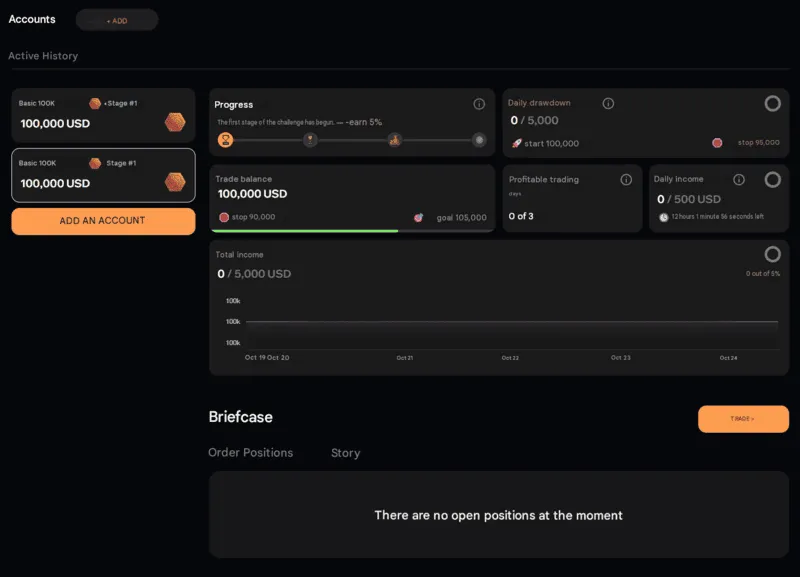
Upscale offers flexible challenge plans built for different trading styles. You choose your starting capital (from $10,000 to $200,000), profit target (typically 8–15%), challenge period (30–60 days), and maximum drawdown (5–10%). The more aggressive the terms, the more expensive the challenge — but the higher the profit split, too.
The profit split runs as high as 90% in the trader’s favor — one of the best figures in the market. For example, if you earn $10,000 on the account, you’ll take home $9,000, and $1,000 goes to the company. Payouts happen automatically through smart contracts in USDT or TON — no requests, no waiting, no reviews.
Additional Features
The platform keeps adding new features. Already announced: copy-trading (mirroring the trades of successful traders), social leaderboards (top traders ranked by monthly profit), automated trading bots, and TradingView integration for technical analysis. Telegram-based support is also up and running, typically responding within an hour.
Blockchain transparency is a standout feature in its own right. Every operation (deposits, payouts, the prop fund’s balance) is recorded on TON and available for anyone to check. You can see at any time how much money is in the fund, and who got paid and when — which rules out any suspicion of a scam.
How to Get Started with Upscale?
Alright, enough theory — let’s walk through the practical steps of signing up and starting to trade. The process is about as simplified as it gets, taking roughly 10–15 minutes from zero to your first trade. Here’s the step-by-step guide for beginners:
Step 1. Install Telegram and set up a crypto wallet.
If you don’t already have Telegram, download it on your phone or computer — it’s your main channel for interacting with the platform. Next, you’ll need a crypto wallet to pay for the challenge and receive payouts. Any wallet that supports USDT (TRC-20 or TON) will work — Trust Wallet, MetaMask, Tonkeeper, or Telegram’s built-in wallet, for example. If you’re completely new to crypto, Tonkeeper is the simplest option for the TON network.
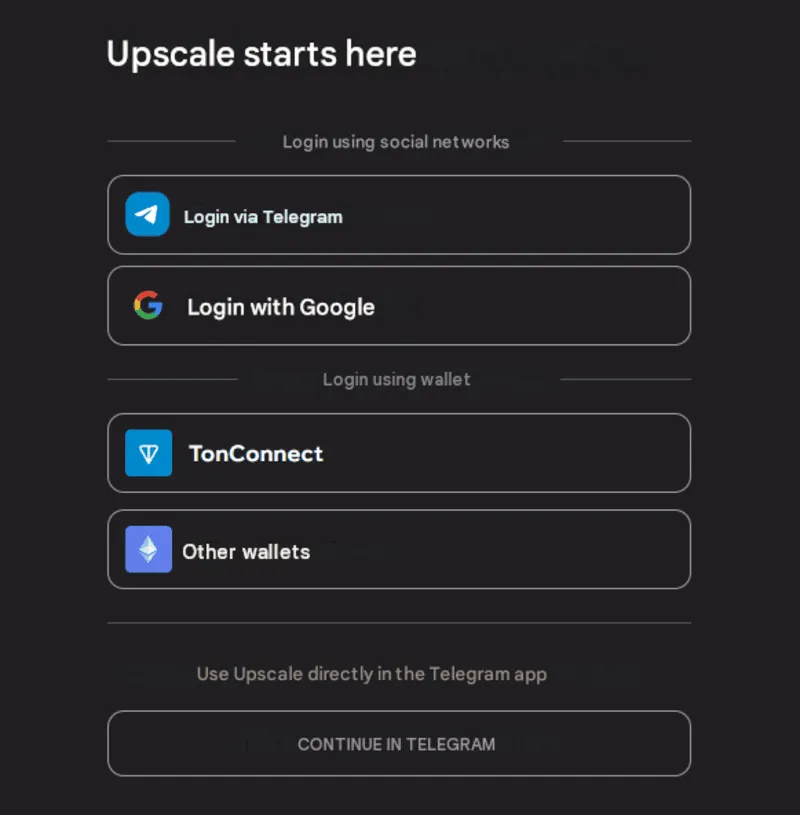
Step 2. Find the official Upscale bot.
Go to the official Upscale site and look for the “Start Trading” or “Launch App” button — it’ll redirect you to the platform’s Telegram bot. Important: don’t search for the bot through Telegram’s search bar, since you might run into scam impersonators. Only use the official site or verified links from the community.

Step 3. Complete quick registration.
The bot will ask you to press “Start” or type “/start” — and that’s it, registration is done. No email, no passport, no selfie with your ID — the system simply links your Telegram ID to your account. Next, the bot will prompt you to connect a crypto wallet: enter the address of your USDT or TON wallet (where payouts will be sent). This takes about 30 seconds.
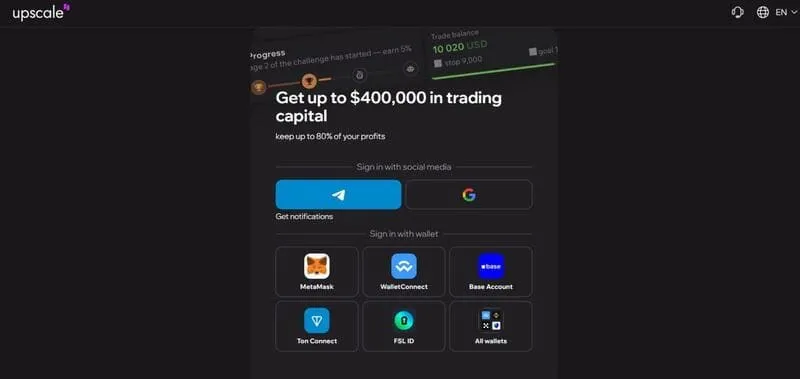
Step 4. Try the demo mode (optional, but useful).
If you’re a beginner or want to test the platform risk-free, launch a demo account. The bot will give you a virtual balance (usually $50,000–$100,000), and you can trade on real market data. Try opening a few trades, get familiar with the interface, and practice setting stop-losses and take-profits. It’s free and helps you avoid dumb mistakes once you’re on real capital.

Step 5. Choose your challenge pricing plan.
- Once you’re ready for real trading, head to the “Challenges” section. The platform will present several options:
- capital from $10,000 to $200,000 (the larger the sum, the higher the challenge cost);
- asset category — Crypto only, RWA (Forex plus precious metals), or ALL;
- a profit target, typically 8–15% over the challenge period;
- a maximum drawdown of 5–10% of starting capital;
- a duration of 30, 60, or 90 days.
Beginners should start with minimum capital ($10,000–$25,000), a conservative target (+8–10%), a 60-day duration, and up to a 10% drawdown. That gives you more room for mistakes and time to adjust.

Step 6. Pay for the challenge in crypto.
Once you’ve picked your plan, the bot will show the challenge cost (typically $50 to $500 depending on the parameters). You’ll be given an address to send USDT or TON to. Open your crypto wallet, send the exact amount to the given address, and wait for the blockchain to confirm the transaction (30–60 seconds for TON, 1–3 minutes for USDT TRC-20). Once the payment clears, the bot automatically activates your challenge.
Step 7. Start trading.
You now have access to trading capital. A “Trade” button will appear in the bot — tap it, pick an asset from the list (say, BTC/USDT), specify your trade direction (Long/Short), position size, leverage, stop-loss, and take-profit. The bot opens the order instantly, and you’ll see it under “My Positions.” From there, you can close the trade manually, adjust your stops, or just watch your PnL (Profit and Loss).
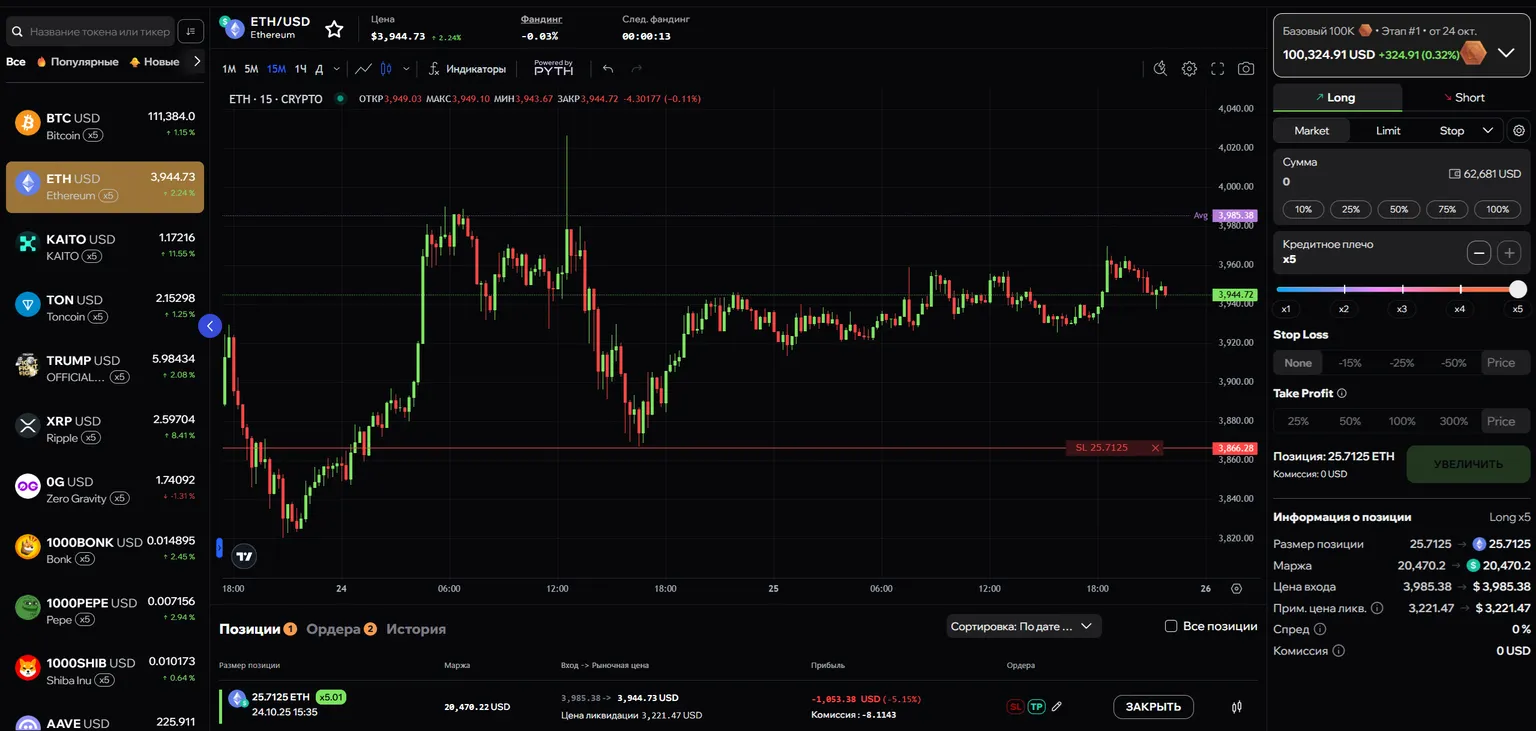
Step 8. Track your challenge progress.
The bot continuously shows your stats: current balance, profit percentage, maximum drawdown, and days remaining in the challenge. Keep an eye on your drawdown limit (breaching it fails the challenge) and aim to hit your profit target ahead of schedule. If you reach the target early, great — the challenge is cleared, and you can withdraw your profit.
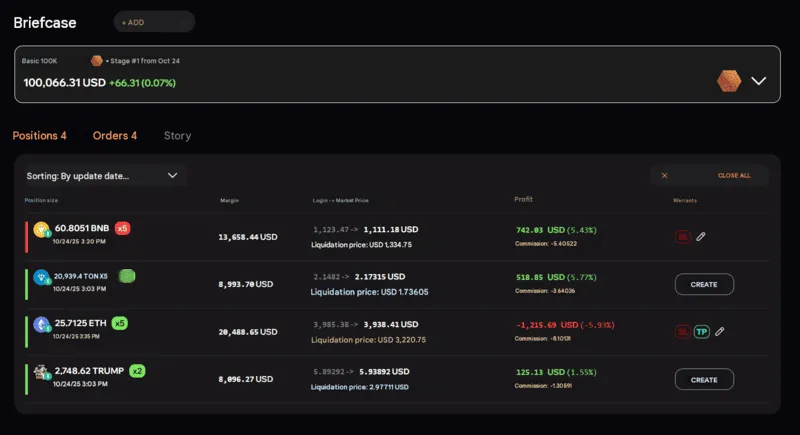
Step 9. Withdraw your first profit.
Once you’ve cleared the challenge (earned the required percentage without a critical drawdown), a “Withdraw Funds” button will appear in the bot. Enter the amount, confirm, and the money automatically goes to your crypto wallet via smart contract. Payouts typically arrive within 5–10 minutes. No forms, no document checks, no two-week wait — a genuine Web3 experience.
After a successful challenge, you can take on a new plan with more capital. For example, clear $10,000 — move up to $25,000, then $50,000, $100,000, and eventually $200,000. Every level up grows both your potential profit and your profit-split percentage. The key is staying disciplined, sticking to risk management, and not getting greedy with leverage.
Common Mistakes and How to Avoid Them
Even trading the company’s capital, traders manage to blow their accounts, and the reasons are usually the same. Let’s break down the typical mistakes beginners and experienced traders make on Upscale, so you can avoid these pitfalls.
Mistake #1. Ignoring risk management
The most common cause of blowing an account is trading with no stop-loss, using the full available capital. The logic seems reasonable: “It’s $50,000 from the company, not my own money, might as well take the risk!” But the challenge rules still apply — a drawdown over 5–10% and you’re out. One bad trade at 100x leverage can wipe out a week’s progress.
How to avoid it: The golden rule — risk a maximum of 1–2% of your capital per trade. On a $50,000 account, your stop-loss should sit at $500–$1,000 in loss, no more. Always set your stops before opening a position, not “I’ll add it later.” Use moderate leverage of 5–10x to start, not 100x right out of the gate. Remember: in prop trading, the winner isn’t whoever made the most in a day — it’s whoever lasted the longest without a critical drawdown.
Mistake #2. Revenge trading
A classic: you lose $2,000 on a bad Bitcoin trade, and immediately open a new position with double the size to “win it back.” Emotions spike, logic shuts off, and instead of recovering, you dig an even deeper hole. Revenge trading is a direct path to blowing an account within a couple of hours.
How to avoid it: After a losing trade, take a break of at least 30–60 minutes. Step away from the Telegram bot, grab a coffee, walk around. Analyze what went wrong: was it a strategy mistake, or just bad luck? If you’ve had 2–3 losing trades in a row in one day, close the terminal and come back tomorrow. The market isn’t going anywhere, but your capital can vanish fast. Keep a trading journal: log every trade, your emotions, and the reasoning behind your entries — it helps you spot patterns in your own behavior.
Mistake #3. Trading with no strategy
Many traders come into Upscale with a casino mindset: “I’ll just guess Bitcoin’s direction and it’ll work out.” They open trades on a whim, watch Twitter for news, and follow “signals” from dubious channels. The result is predictable — chaotic trading with no system leads to unpredictable losses.
How to avoid it: Before starting a challenge, define your trading strategy. It could be scalping on 5-minute candles, swing trading on daily charts, trading off support/resistance levels, or trend following. Test your strategy in demo mode for at least 2–3 weeks. If it shows consistent profit, move to real capital. Don’t hop between strategies every day — discipline beats talent in prop trading.
Mistake #4. Overusing leverage
100x leverage looks tempting: you could earn 50% in a couple of hours. But the reality is even a 1% move against you at that leverage liquidates your position. Beginners don’t grasp just how volatile crypto is — Bitcoin can easily swing 3–5% in an hour, and your deposit simply disappears.
How to avoid it: If you’ve been trading for less than a year, forget about leverage above 10x. Yes, your profit will be smaller, but your odds of surviving the whole challenge go way up. Experienced traders only use high leverage on short timeframes with tight stops. Remember the formula: the higher the leverage, the smaller your position size should be. It’s better to earn 2% with 5x leverage than blow 20% with 50x.
Mistake #5. Ignoring fees and funding
Upscale’s fee is just 0.008%, but if you’re making 50 trades a day, that adds up to a meaningful amount. There’s also funding on perpetual futures — a periodic payment between longs and shorts every 8 hours. On volatile assets, funding can hit 0.1–0.3% a day, and if you hold a position for a week, you lose 2–3% of net profit.
How to avoid it: For scalping, stick to the most liquid pairs (BTC, ETH, SOL), where spreads are tightest. Check the funding rate before opening a position — the bot usually shows this info. If funding is strongly positive (above 0.1%), avoid longs and consider shorts instead. Don’t hold positions through multiple funding payments without good reason — it eats into your profit.
Mistake #6. Trading during RWA off-hours
If you picked a plan with the RWA category (Forex and precious metals), remember the schedule: trading pauses on weekends from Friday 21:00 UTC to Monday 00:00 UTC. Beginners forget this and leave positions open over the weekend, then get hit with a gap Monday morning (a sharp price jump when the market reopens). A gap can blow through your stop-loss — or hand you an unexpected profit — but either way, it’s pure gambling.
How to avoid it: Close all your Forex and gold positions before Friday evening. If you want to trade 24/7 with no pauses, take the Crypto plan — that market never stops. Also check before withdrawing funds that you don’t have open positions on paused markets, or the withdrawal won’t go through.
Mistake #7. Underestimating psychology
Trading someone else’s capital comes with a different psychology. On one hand, it’s not technically your money, so you might feel bolder. On the other, there’s real pressure: “If I blow a $300 challenge, I have to buy a new one, and I’ve lost time.” Many traders get anxious at the smallest drawdown, closing profitable trades too early or holding losing ones too long.
How to avoid it: Treat the challenge as a marathon, not a sprint. The goal isn’t earning 15% in the first week — it’s steadily working toward the result. Use the “set your stops and close the terminal” approach — don’t sit staring at charts for hours. Most successful traders check positions 2–3 times a day, not every 5 minutes. Quality rest, exercise, and good sleep all affect the quality of your trading decisions.
Mistake #8. Skipping education
Upscale gives you capital, but not knowledge. Many people think that getting $50,000 automatically makes them a pro. In reality, without understanding technical analysis, candlestick patterns, support/resistance levels, and indicators, trading turns into roulette.
How to avoid it: Spend at least a month learning before starting a real challenge. Watch free courses on YouTube, read books (Steve Nison’s “Japanese Candlestick Charting Techniques,” Murphy’s “Technical Analysis of the Financial Markets”), and study the materials in Upscale’s community. Practice in demo mode until you can string together at least 20 profitable trades in a row. Only then move to real capital. Remember: prop trading is a profession, not a get-rich-quick scheme.
Upscale Reviews
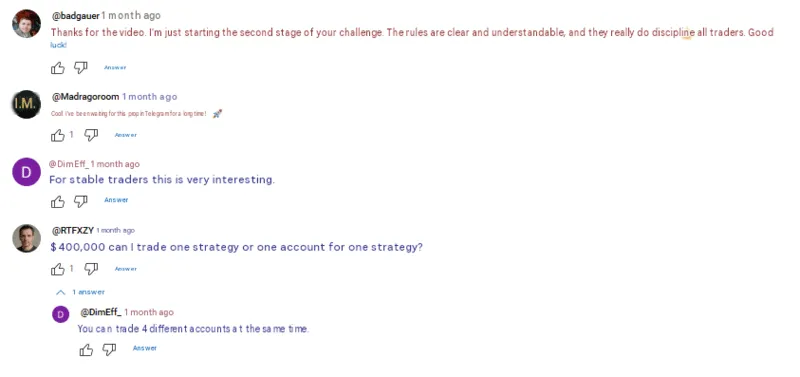
Upscale is a young platform, launched in 2024, so there aren’t as many reviews yet as you’d find for seasoned players like FTMO. But an active community of traders has already formed, sharing their experience in Telegram channels and on crypto forums.
Positive reviews mostly focus on convenience and speed. Traders praise the instant, no-KYC payouts — “sent USDT, the challenge was active in 5 minutes, and a week later I withdrew my first profit to my wallet.” Many highlight the low 0.008% fee as a serious competitive edge for scalpers. The Telegram integration draws praise too — no fiddling with installing terminals, everything’s in one app. Experienced crypto traders point to the advantages of the Web3 approach: transparent transactions on the TON blockchain, no geographic restrictions, and the ability to trade anonymously. One user wrote: “Finally, a prop firm for crypto people, not just Forex dinosaurs.” The wide asset selection also gets positive marks — more than 200 trading pairs, including memecoins and AI tokens.
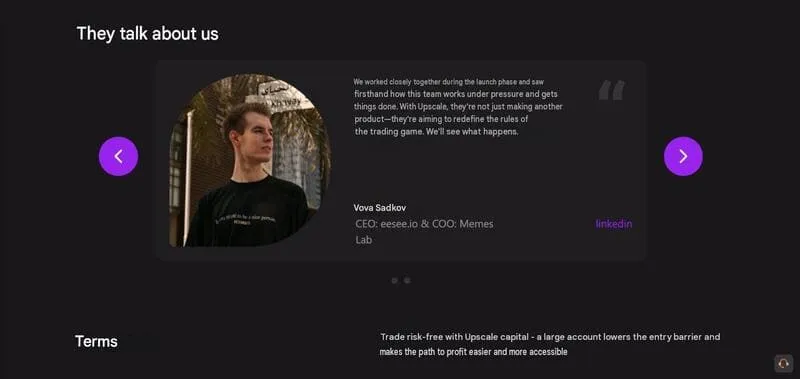
There’s criticism and some concern too. Some reviews mention the challenges being tough for beginners — an 8–15% monthly profit requirement with a 5–10% drawdown cap is seen as strict. A few users reported technical glitches during periods of high market volatility, though the team addressed the issues quickly.
Overall, the platform’s standing within the crypto community is positive — traders note that Upscale genuinely pays out earned money and operates transparently. Negative reviews about non-payment or scam behavior are hard to find, which is a good sign for a young project. Many recommend starting with the smallest challenges ($10,000–$25,000 in capital) to test the system without significant risk.
Growth Prospects
Upscale is still at the very start of its journey, which is both a risk and a huge opportunity. The platform launched in 2024, right as the crypto market entered a new growth phase and Web3 technology finally started seeing mass adoption. The Storm Trade team has already stated an ambitious goal — becoming a top-3 global prop firm by 2027. It sounds bold, but looking at the pace of development, it’s genuinely within reach
The first growth track is expanding the platform’s feature set. Several major updates have already been announced: copy-trading (automatically mirroring successful traders’ trades), social leaderboards ranking top traders by profitability, and TradingView integration for full technical analysis. There are also plans to launch trading bots — algorithms that trade a set strategy with no emotion, 24/7.
Integration with other blockchains looks especially promising. Upscale currently runs on TON, but the team is exploring connecting Ethereum, Solana, Arbitrum, and other networks. That would open access to liquidity on decentralized exchanges (Uniswap, PancakeSwap) and let traders work with tokens that aren’t yet listed on centralized platforms. Imagine being among the first to trade a new project right after its DEX listing, using a prop firm’s capital.
The maximum available capital right now is $200,000, but that’s clearly not the ceiling. As the Upscale fund grows, the plan is to raise the cap to $500,000, and for VIP traders, up to $1,000,000 and beyond. That would put the platform on par with institutional players. There’s also discussion of a tiered loyalty system: the longer you trade successfully, the better your terms get — a higher profit split (up to 95%), lower challenge requirements, and more capital.
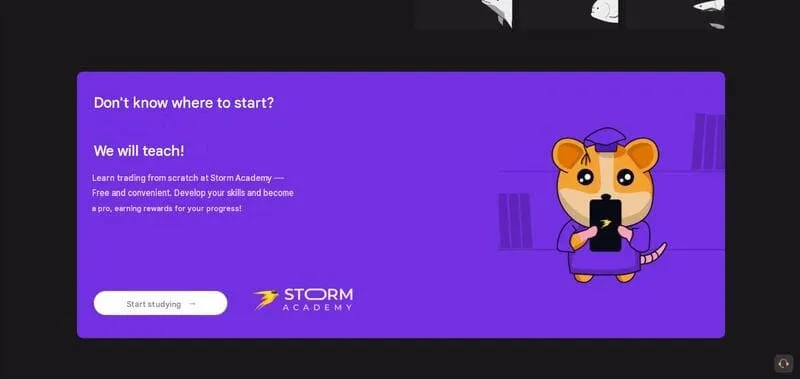
Upscale understands that trader success is company success. That’s why a full academy is in development, with free courses on technical analysis, risk management, and trading psychology. Webinars with professional traders, breakdowns of real trades, and mentorship for beginners are all planned. The more traders learn to earn consistently, the more profit the prop fund itself generates.
Upscale’s core audience today is largely English-speaking traders alongside a genuinely international user base. The team is actively working on localizing into more languages: Spanish, Portuguese, Chinese, Arabic. Emerging markets look especially promising — Latin America, Southeast Asia, Africa — where millions of people lack access to traditional financial tools but actively use crypto. Upscale’s Web3 format is a perfect fit for these regions: no bank accounts or document verification needed, just a smartphone and a crypto wallet.

One interesting angle is the relationship with regulators. Classic prop firms operate in a legal gray area in many countries, since they’re technically providing financial services without a license. Upscale runs on a Web3 model, where smart contracts automatically enforce conditions with no legal entity directly involved. That could either shield it from regulatory pressure (there’s no centralized company to shut down) or create new problems (some countries are tightening controls on crypto).
Prop trading as a phenomenon is growing exponentially. Where it was a niche story back in 2020, by 2026 hundreds of thousands of traders worldwide are using prop capital. Interest is growing especially fast within the crypto community — younger traders don’t want to risk their own money in a volatile market, but they’re happy to trade someone else’s capital for a cut of the profit.
Web3 integration is a mega-trend for the next 5–10 years. Decentralized finance (DeFi) already manages tens of billions of dollars, and Upscale sits at the intersection of two hot niches: prop trading and Web3. If the team can hold onto its technological lead and avoid security failures (the top risk for any crypto project), the odds of becoming a category-defining player are genuinely high.
Of course, it’s not all smooth sailing. The main risks: intensifying competition (other prop firms will start adopting Web3 too), technical vulnerabilities in smart contracts (if hackers breach the system, traders bear the consequences), and regulatory pressure on crypto. There’s also a risk that a bear market in crypto could dampen interest in trading and slow new-user growth. But overall, the direction is right. Upscale solves a real problem: giving capital access to people who have the skill but not the money. And Web3 technology makes that as accessible, fast, and transparent as possible. If the team keeps up this pace, Upscale could become a household name in the prop trading industry within 2–3 years.
Conclusion
Upscale is a genuinely fresh take on prop trading, finally adapted for the crypto market and modern technology. The platform proves you can trade serious capital with no bureaucracy, no KYC verification, and no multi-day payout waits. Its Web3 architecture on the TON blockchain delivers transparency, instant transactions, and full anonymity — exactly what classic prop firms have been missing.
Yes, the project is young, and it has some growing pains: technical glitches happen occasionally, the community isn’t as large as FTMO’s yet, and long-term reliability is still an open question. But the potential is huge: a 0.008% fee, up to $200,000 in capital, 200+ trading pairs, and Telegram integration all make Upscale one of the most convenient platforms out there for crypto traders.
Is this platform right for you? If you’re an active crypto trader tired of risking your own money; if you value speed, mobility, and minimal formalities; if you’re ready for crypto market volatility and understand the risks — Upscale is worth trying. Start with the demo mode, then take a minimum challenge at $10,000–$25,000, and see how the system works from the inside.
Frequently Asked Questions
Do you need identity verification (KYC) to trade on Upscale?
No, Upscale requires no identity verification at all — that's one of the key advantages of a Web3 platform. Registration happens through Telegram, and the system simply links your account to your Telegram ID. You don't need to upload a passport, take a selfie with your ID, verify your address, or wait several days for review, the way you would with classic prop firms like FTMO or FundedNext. Paying for a challenge and receiving payouts is handled in crypto (USDT or TON), transferred to your wallet automatically through smart contracts. This ensures full anonymity and lets traders from any country participate, including places where access to traditional financial markets is restricted. All you'll need is a crypto wallet to handle digital assets.
How long does it take to withdraw profit from Upscale?
Payouts on Upscale happen nearly instantly, thanks to smart-contract technology on the TON blockchain. Once you've successfully cleared a challenge — hitting your profit target without breaching the drawdown limit — a "Withdraw Funds" button appears in the Telegram bot. You specify the amount, confirm the transaction, and the money is automatically sent to your crypto wallet. The whole process usually takes 5 to 15 minutes — the time needed for the TON blockchain to confirm the transaction. No withdrawal requests, no manager reviews, no waiting 5–10 business days for a bank transfer like with competitors. This is a fundamental difference from traditional prop firms, where the payout process can drag on for weeks. Payouts arrive in USDT or TON directly at the address you provided during registration. One important detail: your first withdrawals may carry limits (say, up to $5,000 at a time) as a fraud safeguard, but those restrictions get lifted for traders with a track record of successful trading.
What's the minimum budget needed to get started on Upscale?
The minimum entry threshold on Upscale is significantly lower than most competitors, making the platform accessible even to beginner traders. Challenge cost depends on your chosen parameters: capital size, profit target, duration, and asset category. The most basic plans with $10,000–$15,000 in capital typically cost $50 to $150. For comparison, FTMO's minimum challenge starts at $200–$300, and some prop firms start at $500. So you can start with the cost of dinner at a restaurant and get access to trading tens of thousands of dollars of the company's capital. Before buying a real challenge, it's worth using the demo mode, which is completely free and lets you test every platform feature on a virtual balance. You should also factor in blockchain fees when paying for a challenge in crypto — usually just cents ($0.50–$2) on the TON or TRC-20 network. Overall, with a budget of $100–$200, you can comfortably start trading on Upscale and test a few strategies.
Can you trade on Upscale from your phone?
Yes — in fact, mobile trading is the primary way to use Upscale, since the whole platform is built into Telegram. You don't need to install separate terminals like MetaTrader, set up a VPN, or work exclusively from a computer. Just open Telegram on your smartphone (iOS or Android), go into the Upscale bot, and you get full access to every feature: opening and closing positions, managing stop-losses and take-profits, monitoring your balance and profit, and withdrawing funds. The interface is about as simplified as it gets, with clear buttons and intuitive navigation, so even a beginner will figure it out in a couple of minutes. This is especially convenient for scalpers and active traders who want to watch the market and place trades on the go — on transit, at a café, while traveling. The one limitation: for detailed technical analysis with indicators and charts, a computer or TradingView integration (currently in development) works better. But for most traders, the mobile bot's functionality is more than enough for comfortable trading.
What happens if I fail the challenge — do I lose my money?
Yes, if you don't meet the challenge conditions (you don't hit the profit target or you breach the drawdown limit), the challenge fee isn't refunded. This is standard practice across every prop firm — the challenge fee is the cost of accessing capital and having your trading skills evaluated. For example, if you paid $150 for a challenge with $50,000 in capital but blew the account by breaching the 10% drawdown limit, that $150 stays with the company. That's exactly why it's so important to approach prop trading responsibly: test your strategy in demo mode, study the risk-management rules, and don't chase fast profit. Many beginners make the mistake of buying an expensive $100,000+ challenge right away, then blowing it within a couple of days due to inexperience. The right approach is to start with a minimum challenge ($10,000–$25,000 in capital for $50–$100), learn to clear it consistently, and only then scale up to larger sums. If you successfully complete the challenge and turn a profit, your $150 pays for itself many times over — for example, earning $5,000 on the account with an 80/20 split gets you $4,000 net. In that sense, the challenge is an investment in the opportunity to trade meaningful capital, and it's a worthwhile one for traders who are confident in their skills.
Trader Reviews
Related Articles:















- Prop Trading and Web3 (Web 3.0), Explained
- Upscale Platform Overview
- The Story Behind Upscale
- How Upscale Stands Apart from Competitors
- Upscale’s Core Features and Capabilities
- Trading Assets and Markets
- Technical Trading Capabilities
- Interface and Access
- The Challenge System and Capital
- Additional Features
- How to Get Started with Upscale?
- Common Mistakes and How to Avoid Them
- Upscale Reviews
- Growth Prospects
- Conclusion

Top 10 Best Prop Firms
| # | Prop Firm | Rating | Assets | Profit Split | Funded Capital | Challenge Fee | Founded | Promo Code | Website |
|---|---|---|---|---|---|---|---|---|---|
|
1
|
4.9
|
Crypto, Stocks, Indices, Metals, Energy
|
Up to 90% | Up to $200,000 | From $79 | 2023 |
20% discount
RANK20
|
Visit Website | |
|
2
|
4.8
|
Crypto, Forex
|
Up to 90% | Up to $200,000 | From $99 | 2023 |
20% discount
RANK20
|
Visit Website | |
|
3
|
4.7
|
Prediction Markets, Polymarket
|
Up to 90% | Up to $50,000 | From $30 | 2026 |
25% discount
RANK25
|
Visit Website | |
|
4
|
4.7
|
Crypto, Forex, Other Assets
|
Up to 90% | Up to $200,000 | From $59 | 2024 |
10% discount
Follow the link
|
Visit Website | |
|
5
|
4.7
|
Crypto
|
Up to 90% | Up to $200,000 | From $59 | 2023 |
10% discount
Follow the link
|
Visit Website | |
|
6
|
4.6
|
Crypto, Forex, Stocks, Indices, Metals, Energy
|
80%–100% | Up to $200,000 | From $49 | 2026 |
30% discount
RANK30
|
Visit Website | |
|
7
|
4.6
|
Forex, Stocks, Indices, Metals
|
Up to 90% | Up to €300,000 | From €40 | 2023 |
30% discount
RANK30
|
Visit Website | |
|
8
|
4.5
|
Crypto, Forex, Indices, Metals
|
80%–100% | Up to $200,000 | From $89 | 2013 |
No Promo Code
|
Visit Website | |
|
9
|
4.5
|
Crypto, Forex
|
Up to 90% | Up to $200,000 | From €79 | 2015 |
No Promo Code
|
Visit Website | |
|
10
|
4.3
|
Crypto, Forex, Other Assets
|
60%–95% | Up to $200,000 | From $32 | 2024 |
20% discount
HELLO
|
Visit Website |