



Position Size in Trading: How to Calculate Your Entry Amount and Manage Risk

Every trader — beginner or professional — eventually runs into the question: how much money should go into a single trade? The answer determines not just the outcome of that one trade, but the fate of the entire trading account. Correctly calculating position size protects your capital during a string of losing trades, keeps risk at an acceptable level, and lets you trade systematically — without impulsive decisions driven by greed or fear.
This article breaks down: the position-size formula with concrete numbers; how a stop-loss affects your final risk; three key risk-management methods for different trading strategies; a comparison of approaches for Forex, futures, and crypto; and the common mistakes that wreck deposits even when the signals are profitable. Read on — you’ll come away with a ready-to-use process you can apply on your very next trade.

- How to Calculate Position Size: The Mechanics and Formula
- Four Risk-Management Methods: Which One Fits Your Strategy
- Step-by-Step Guide: Calculating Position Size Before a Trade
- Comparing Position-Sizing Approaches Across Different Markets
- Risks and Mistakes in Position-Size Management
- Statistics and Data: Why Math Beats Intuition
- Current Trends in Position-Size Management
- Conclusion: What to Do Next
How to Calculate Position Size: The Mechanics and Formula
Risk management in trading rests on one fundamental principle: the loss from a single trade shouldn’t exceed a pre-set percentage of the trading account. This rule is called risk per trade, and it’s the foundation of every position-size calculation.
The base formula looks like this: Position Size = (Account Size × Risk%) ÷ Stop-Loss Distance in Account Currency.
Let’s work through an example. A trader’s deposit is $10,000. The allowed risk per trade is 1%, or $100. The entry price on a stock is $50, with the stop-loss set at $48. The distance to the stop is $2 per share. Divide $100 by $2, and you get 50 shares. That’s exactly how many shares can be bought without exceeding the allowed risk.
On Forex and futures, the calculation gets more complex because of leverage. Leverage increases the size of the open position, but it doesn’t change the dollar risk — that’s still determined by the stop-loss. A common beginner mistake is calculating size based on margin rather than the distance to the stop. The result is predictable: one trade wipes out 20–30% of the deposit instead of the planned 1–2%.
For the crypto market, it’s important to account for the instrument’s volatility. Bitcoin can move 3–5% in an hour — a 0.5% stop would get knocked out by random noise. That’s why risk in crypto is often set at 0.5–1% of the account with a wide stop (3–8%), rather than the other way around. This reduces the number of coins in the position, but preserves the deposit through a string of losses.
The formula works the same way for long and short positions. In the futures market, you also need to factor in the tick size and its dollar value. For example, in a WTI crude oil contract, one tick equals $0.01, and the tick value is $10. If the stop is set at 50 ticks, the risk per contract comes to $500. A trader with a $25,000 deposit and 1% risk ($250) can open half a contract — and no more.
Four Risk-Management Methods: Which One Fits Your Strategy
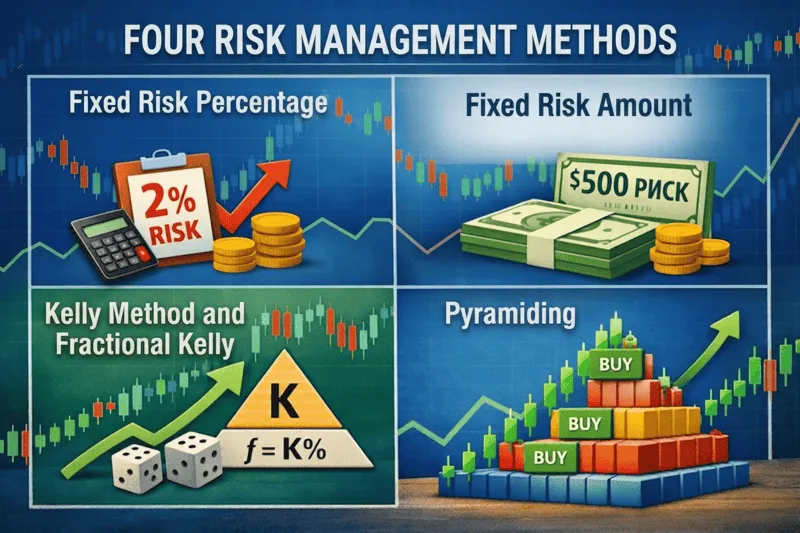
1. Fixed Percentage Risk
The most common approach: a trader sets a single risk percentage for every trade — typically 1–2% of the trading account. Position size gets recalculated before every entry based on the current balance. This method automatically shrinks size after losses and grows it after wins, making it self-balancing. It suits traders of any experience level and trading horizon.
2. Fixed Dollar Risk
Instead of a percentage, the trader sets a specific dollar amount — say, $50 per trade. This is psychologically simpler: losing $50 feels predictable. The downside: as the account grows, the risk doesn’t scale up, and during a drawdown, that fixed amount starts eating up an ever-larger share of capital. This is optimal for beginners with a small deposit who are learning to control their emotions.
3. The Kelly Criterion and Fractional Kelly
The Kelly criterion calculates optimal bet size based on win probability and the profit/risk ratio. The formula: K% = W − (1−W)/R, where W is the percentage of winning trades and R is the ratio of average profit to average loss. At a 55% win rate and R=1.5, you get K = 0.55 − 0.45/1.5 = 25%. Full Kelly is too aggressive for real trading — traders use fractional Kelly (½ or ¼ Kelly), which reduces account volatility without a significant loss of return. The method requires reliable statistics from at least 100 trades.
4. Pyramiding — Scaling into a Profitable Position
Pyramiding means adding to an open position as it moves in your favor. Each addition is smaller than the last: the first entry might be 60% of the position, the second 30%, the third 10%. The combined stop-loss moves to breakeven as you add. This method amplifies profit during strong trends, but demands strict discipline — chaotic adding turns a winning position into a losing one.
Step-by-Step Guide: Calculating Position Size Before a Trade

Step 1. Determine your trading account size.
Write down your current balance — not margin, not open positions, but the actual funds in the account. For prop trading, this is your allocated capital limit. Risk gets calculated off this figure. A common mistake: using your original deposit amount when you already have open losing trades — risk should be calculated off your current actual balance.
Step 2. Set your allowed risk per trade.
Beginners are recommended to use 0.5–1% per trade. Traders with stable statistics from 200+ trades can use 1.5–2%. Above 3% is aggressive-trading territory, with a high chance of wiping out the account after a string of 5–7 losses. Do the math: at 2% risk and 10 losses in a row, your balance drops 18%. At 5% risk, it drops 40%.
Step 3. Find your stop-loss level.
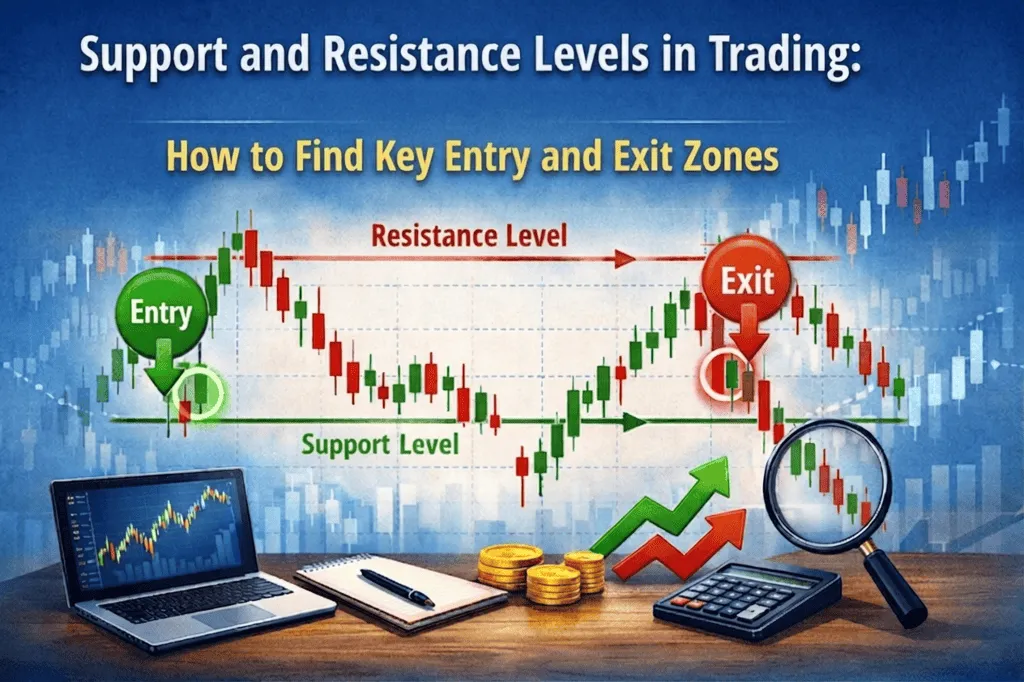
The stop gets placed before you calculate size — never the other way around. A technically sound stop sits beyond the nearest significant level: support, resistance, a local extreme. The distance in points or percent from your entry price is your stop-loss for the formula.
Step 4. Calculate your dollar risk.
Multiply your account size by your risk percentage. Example: a $5,000 account × 1% = $50. That’s the maximum amount you’re willing to lose on this trade.
Step 5. Calculate your position size.
Divide your dollar risk by the distance to your stop in dollar terms. If a stock costs $100 and your stop is at $97 ($3 per share), with a $50 dollar risk: 50 ÷ 3 = 16 shares. Always round down — never up.
Step 6. Check the position against margin requirements.
Make sure the margin needed to open the position doesn’t exceed 20–30% of your deposit. Otherwise, if you open several trades at once, your broker may force-close positions. This matters especially for leveraged Forex and futures trading.
Step 7. Log your parameters and execute.
Record: the instrument, entry price, stop size, position size, and dollar risk. This isn’t bureaucracy — it’s a trading journal that, after 100 trades, will show you where your strategy works and where it breaks down. Without a journal, improving your results is impossible.
Comparing Position-Sizing Approaches Across Different Markets

Forex, futures, stocks, and crypto all use different units of size, different point values, and different constraints. The table below helps you quickly get oriented when choosing an instrument.
| Market | Size Unit | Point Value | Typical Stop | Recommended Risk% | Notes |
|---|---|---|---|---|---|
| Forex (EUR/USD) | Lot (100,000 units) | $10/pip (standard) | 20–50 pips | 0.5–1% | Leverage up to 1:500; micro-lots from 0.01 |
| Futures (ES) | Contract | $12.50/tick | 4–8 ticks | 1–2% | Day margin ~$600; overnight higher |
| Stocks (NYSE/NASDAQ) | Shares | Depends on price | 2–5% of price | 1% | No leverage by default; shorting via broker |
| Crypto (BTC) | BTC/USDT | Depends on price | 3–8% of price | 0.5–1% | High volatility; trades 24/7 |
| Index CFDs | Contract | $1–10/point | 10–30 points | 0.5–1% | Overnight fee (swap); leverage up to 1:20 in the EU |
For beginners, unleveraged stocks and crypto are the most intuitive markets: position size is measured in units of the asset, and risk is calculated in a straight line. Forex and futures require understanding the concept of “point value” and margin calculation, or the trade’s real risk ends up several times higher than planned.
Risks and Mistakes in Position-Size Management

Mistake 1. Ignoring the Stop-Loss
Some traders open a position with no clear stop — “I’ll see how it goes.” Without a stop-loss, the size formula simply doesn’t work: the risk amount becomes unknown. In practice, 80% of catastrophic losses on retail accounts happen precisely on trades with no protective order. How to minimize it: always set your stop before entering, never after.
Mistake 2. Oversized Risk After a Losing Streak
After three to five losses in a row, the urge to “win it back” kicks in — increasing size to quickly recover losses. This is known as martingale behavior in trading psychology. The result is predictable: one doubled loss wipes out all the previous losses and adds more. With a string of 6 losses doubling at 2% risk each, the account loses 75%. How to minimize it: during a drawdown of more than 10%, cut your risk to 0.5% and recover slowly.
Mistake 3. Opening Correlated Positions at the Same Time
A trader opens EUR/USD and GBP/USD in the same direction, treating them as two independent trades. But these pairs are 80–90% correlated — the real risk doubles. The same applies to stocks within one sector. How to minimize it: sum up the risk of correlated positions and treat them as a single trade.
Mistake 4. Sizing the Stop Off Desired Profit, Not a Technical Level
“I want to make $200, so my stop is $100, a 2:1 ratio.” A stop placed based on math rather than technical analysis will get knocked out by ordinary market noise. The position closes at a loss, then price reverses — a classic trap. How to minimize it: first identify the technical level, then calculate the risk/reward ratio. If it’s below 1:1.5, skip the trade.
Mistake 5. Manually Moving the Stop Mid-Trade
As price approaches the stop, the trader moves it further out, hoping for a reversal. Every time, the risk grows beyond what was planned. One instance of this can wipe out the results of 20–30 profitable trades. How to minimize it: a stop can only be moved to reduce risk (to breakeven or better), never to increase it.
Statistics and Data: Why Math Beats Intuition

The Math of Drawdowns
Losses are disproportionately harder to recover from than they seem. A 10% drawdown requires an 11% gain to break even. A 25% drawdown requires 33%. A 50% drawdown requires 100%. That’s exactly why risk management is the priority, not improving signal accuracy. A trader with 45% accuracy and a 3:1 profit/risk ratio earns more than a trader with 65% accuracy and a 1:1 ratio.
Real Statistics on Retail Traders
According to EU regulators (ESMA), 74–89% of retail CFD traders lose money. The main cause isn’t weak signals — it’s poor risk management: trading with no stop, oversized positions, and ignoring correlations. Traders who use a fixed 1–2% risk per trade show statistically much longer account “lifespans.”
The Impact of Risk Size on the Equity Curve
At 1% risk per trade and 50% accuracy, a string of 10 losses in a row shrinks the account by 9.6%. At 5% risk, it shrinks by 40%. Strings of 10 losses happen regularly in trading — that’s a statistical norm, not a catastrophe. A trader with 1% risk rides it out with psychological calm and keeps trading. A trader with 5–10% risk either wipes out the account at that point or starts making chaotic decisions.
Prop Trading and Risk Limits
Prop firms set strict limits: a daily drawdown of 2–5% of allocated capital, and a maximum overall drawdown of 5–10%. Exceeding these limits means an automatic end to trading. A funded trader is forced to work with 0.5–1% risk per trade — and it’s exactly this discipline that builds long-term profitability.
Current Trends in Position-Size Management

Automating the Calculation
Manual size calculation is being replaced by automated systems. Trading terminals (MT5, NinjaTrader, TradingView) offer built-in tools: just enter your stop level and risk percentage, and position size gets calculated automatically. This kind of position-size calculator eliminates arithmetic errors and speeds up trade execution.
Dynamic Risk Based on Volatility
Professional traders are moving from a fixed percentage to a dynamic one: stop size gets tied to ATR (Average True Range), a volatility indicator. During high volatility, the stop is wider and the position smaller; during low volatility, the reverse. This lets you adapt to market conditions and avoid getting knocked out by random noise.
The Growth of Prop Trading and Its Effect on Standards
The number of prop firms funding traders grew from a handful to hundreds between 2019 and 2024. This has standardized approaches to risk management: requirements around maximum drawdown and daily limits have become an industry norm. Traders who make it through prop firm selection show a more disciplined approach to position-size calculation.
Integrating Risk Management with Algorithmic Strategies
In algo trading, position size gets calculated automatically within the trading algorithm itself. Portfolio management systems allocate capital across strategies based on their historical return and volatility. This is the next level of risk management, now accessible to retail traders through platforms like QuantConnect and MetaTrader with MQL5 robots.
Conclusion: What to Do Next

Position size is the foundation of trading — more important than signal accuracy or indicator choice. There’s one rule: calculate the size of every trade using the formula, based on your allowed risk and the distance to your stop. This protects against catastrophic losses and creates a mathematical foundation for long-term capital growth.
For Beginner Traders
Start with 0.5–1% risk per trade. Your first 50 trades should just go into the journal. Don’t move your stop after opening a position. Trade a demo account until size calculation becomes automatic.
For Traders with 6–12 Months of Experience
Analyze your statistics: calculate your average R-ratio and win percentage. Try the fractional Kelly method — it optimizes capital growth for your specific accuracy. Set up a trade journal in Excel with automatic risk calculation.
For Experienced Traders
Consider dynamic risk management via ATR. Test pyramiding on trending instruments. If you trade multiple strategies, split your capital and set limits for each individual “bucket.”
Keep up with new material on PropTradingRank.com — you’ll find articles on trading strategies, trading psychology, and market-analysis tools here.
Frequently Asked Questions
What risk per trade is considered safe for a beginner?
For beginner traders, 0.5–1% of the trading account is optimal. At that level, a string of 10 losses in a row would shrink the deposit by no more than 10%, which is psychologically bearable and mathematically recoverable.
Should you change your risk percentage based on how confident you feel about a trade?
No. Subjective "confidence" is a poor advisor. Traders who increase position size on "obvious" signals tend to take their biggest losses on exactly those trades. A fixed risk per trade removes emotional decisions and keeps your trading consistent.
How do you calculate position size when trading leveraged Forex?
Leverage affects margin, but not the risk calculation. The formula stays the same: dollar risk ÷ stop-loss in dollars. If your stop is 20 pips on EUR/USD, and the pip value for a standard lot is $10, your risk is $200. With a $5,000 deposit and 1% risk ($50): 50 ÷ 200 = 0.25 lots.
Can you trade with no stop-loss by managing risk differently?
Theoretically, yes (through options or hedging), but for most retail traders, trading with no clear stop-loss leads to uncontrolled losses. The market can move against a position far longer than a trader can withstand psychologically and financially.
How does the stop-loss affect the final position size?
Directly proportional. The wider the stop (more points to the protective order), the smaller the position size at a fixed dollar risk. A wide stop isn't losing money — it's adapting to the instrument's volatility. Size shrinks, but risk stays the same.
What is the risk/reward ratio, and why does it matter?
The R-ratio is the ratio of potential profit to risk. R=2 means: with a $50 stop, your target is $100. A trader with 40% accuracy and R=3 will be profitable: 4 losses × $50 = −$200; 6 wins × $150 = +$900. Net result: +$700. Without understanding this ratio, evaluating a strategy is impossible.
How do you manage risk when trading multiple positions at once?
Add up the risk across all open positions. If your limit is 5% of the account across all open trades, and three positions are already carrying 1.5% each, a new trade isn't available until one of the existing ones closes. Account for correlation: two positions in correlated assets double your real risk.
Is it worth using a trailing stop for position management?
Yes, especially in trending markets. A trailing stop automatically moves with price, locking in profit on a reversal. It doesn't replace your initial stop-loss — that defines your entry risk. Trailing stops get activated once price has moved in your favor by at least the size of the original stop.
Related Articles:












- How to Calculate Position Size: The Mechanics and Formula
- Four Risk-Management Methods: Which One Fits Your Strategy
- Step-by-Step Guide: Calculating Position Size Before a Trade
- Comparing Position-Sizing Approaches Across Different Markets
- Risks and Mistakes in Position-Size Management
- Statistics and Data: Why Math Beats Intuition
- Current Trends in Position-Size Management
- Conclusion: What to Do Next

Top 10 Best Prop Firms
| # | Prop Firm | Rating | Assets | Profit Split | Funded Capital | Challenge Fee | Founded | Promo Code | Website |
|---|---|---|---|---|---|---|---|---|---|
|
1
|
4.9
|
Crypto, Stocks, Indices, Metals, Energy
|
Up to 90% | Up to $200,000 | From $79 | 2023 |
20% discount
RANK20
|
Visit Website | |
|
2
|
4.8
|
Crypto, Forex
|
Up to 90% | Up to $200,000 | From $99 | 2023 |
20% discount
RANK20
|
Visit Website | |
|
3
|
4.7
|
Prediction Markets, Polymarket
|
Up to 90% | Up to $50,000 | From $30 | 2026 |
25% discount
RANK25
|
Visit Website | |
|
4
|
4.7
|
Crypto, Forex, Other Assets
|
Up to 90% | Up to $200,000 | From $59 | 2024 |
10% discount
Follow the link
|
Visit Website | |
|
5
|
4.7
|
Crypto
|
Up to 90% | Up to $200,000 | From $59 | 2023 |
10% discount
Follow the link
|
Visit Website | |
|
6
|
4.6
|
Crypto, Forex, Stocks, Indices, Metals, Energy
|
80%–100% | Up to $200,000 | From $49 | 2026 |
30% discount
RANK30
|
Visit Website | |
|
7
|
4.6
|
Forex, Stocks, Indices, Metals
|
Up to 90% | Up to €300,000 | From €40 | 2023 |
30% discount
RANK30
|
Visit Website | |
|
8
|
4.5
|
Crypto, Forex, Indices, Metals
|
80%–100% | Up to $200,000 | From $89 | 2013 |
No Promo Code
|
Visit Website | |
|
9
|
4.5
|
Crypto, Forex
|
Up to 90% | Up to $200,000 | From €79 | 2015 |
No Promo Code
|
Visit Website | |
|
10
|
4.3
|
Crypto, Forex, Other Assets
|
60%–95% | Up to $200,000 | From $32 | 2024 |
20% discount
HELLO
|
Visit Website |