



Risk Management in Trading: How to Protect Your Deposit and Earn Consistently

Most traders lose money not because they can’t analyze the market, but because they ignore risk management in trading. The difference between someone who blows their account in three months and someone who trades for years isn’t a magic trading strategy or access to insider information. It’s the rules of capital management — which one follows and the other ignores.
This article breaks down: what risk management is and why any system falls apart in the long run without it; how to calculate your allowable risk per trade and correctly place a stop-loss; which risk-control tools actually work in practice for crypto and Forex markets in 2026; and the common mistakes beginner traders make, and how to avoid them. If you want to trade consistently, risk management becomes the foundation — without it, there are no profitable trades.
- What Risk Management Is and How It Works in Practice
- Core Approaches to Risk Management in Trading
- How to Build a Risk-Management System: A Step-by-Step Guide
- Tools and Platforms for Risk Management: A Comparative Analysis
- Risks, Mistakes, and Pitfalls in Risk Management
- Statistics and Data: What the Numbers Say About Risk in Trading.
- Current Risk-Management Trends
- Conclusion: Where to Start and What to Do Next
What Risk Management Is and How It Works in Practice
Risk management is a system of rules that determines how much money a trader is willing to lose on each trade, across a string of losing trades, and over a trading period as a whole. In simpler terms: it’s a set of pre-defined loss limits that protect your deposit even during periods when the market moves against you.
The mechanism runs on three key tools. The first is the stop-loss: an order that automatically closes a position once it hits a critical loss threshold. The second is position-size calculation: a trader determines trade size based on allowable risk, not on how much they want to make. The third is the risk/reward ratio: every entry point gets evaluated by how much the potential profit outweighs the possible loss.
Picture your deposit as business capital, and every trade as an individual project. No entrepreneur puts everything they have into one project. They spread out risk and decide in advance at what loss they’ll walk away. A trader needs to operate the same way: open a position with a known maximum loss defined in advance — and only when the potential profit is at least double that loss.
Calculating risk per trade works like this. Say your deposit is $10,000, and your allowable risk per trade is 1%. That means your maximum loss on a single trade can’t exceed $100. If your entry price on an asset is $50, and your stop-loss is set at $48 (a $2 distance), your position size comes to 50 shares (100 / 2 = 50). This approach lets you ride out a string of losing trades without catastrophic damage.
The risk/reward ratio is an equally important element. At a 1:2 ratio, a trader risks $100 to make $200. That means even if 50% of trades end up as losses, the overall trading result stays positive. At a 1:3 ratio, only a third of your trades need to be winners for your deposit to keep growing.
Risk management in trading doesn’t exist without strict discipline. A rule can be perfectly designed on paper, but if a trader moves their stop-loss “because the market’s about to reverse” or doubles their size after a loss hoping to win it back, the whole system falls apart. That’s exactly why risk management is inseparable from trading psychology.
Core Approaches to Risk Management in Trading
Fixed Percentage Risk Per Trade
A trader sets a constant percentage of their deposit to risk on every trade — typically 0.5% to 2%. With a $5,000 deposit and 1% risk, the maximum loss on a single trade is $50. This approach suits most traders: it’s simple to calculate and protects capital even through a long string of losses.
The Fixed Lot Method
Trading the same size regardless of your deposit’s current state. Used by experienced traders with a thoroughly tested trading system. Beginners should approach this with caution: as the deposit shrinks, a fixed lot becomes a disproportionately large risk relative to remaining capital.
The Kelly Criterion
A mathematical formula that calculates optimal position size based on win probability and the profit/loss ratio. It lets you mathematically justify your risk size. In practice, traders use “fractional Kelly” — half or a quarter of the calculated value — to reduce drawdown. This suits anyone keeping detailed statistics on their trades.
Diversification Across Instruments
Spreading capital across several financial instruments reduces dependence on any one asset’s behavior. If some positions are in stocks, some in crypto, and some in futures, it’s unlikely every asset moves against the trader simultaneously. Diversification doesn’t replace a stop-loss, but it lowers the portfolio’s overall risk level.
Daily and Weekly Loss Limits
A trader sets the maximum acceptable loss for a day or a week. Once that threshold is hit, they stop trading until the next period. This method matters especially for intraday trading: emotional decisions after a string of losses wreck a deposit faster than any bad strategy. A loss limit is a “circuit breaker” against emotional mistakes.
How to Build a Risk-Management System: A Step-by-Step Guide

Step 1. Determine your maximum risk per trade.
Decide what percentage of your deposit you’re willing to risk on a single trade. For beginners, no more than 1%; for experienced traders, up to 2%. Write this number down and don’t deviate from it. A mistake at this stage: risking “whatever you don’t mind losing” instead of a pre-defined percentage.
Step 2. Set your stop-loss level before opening the position.
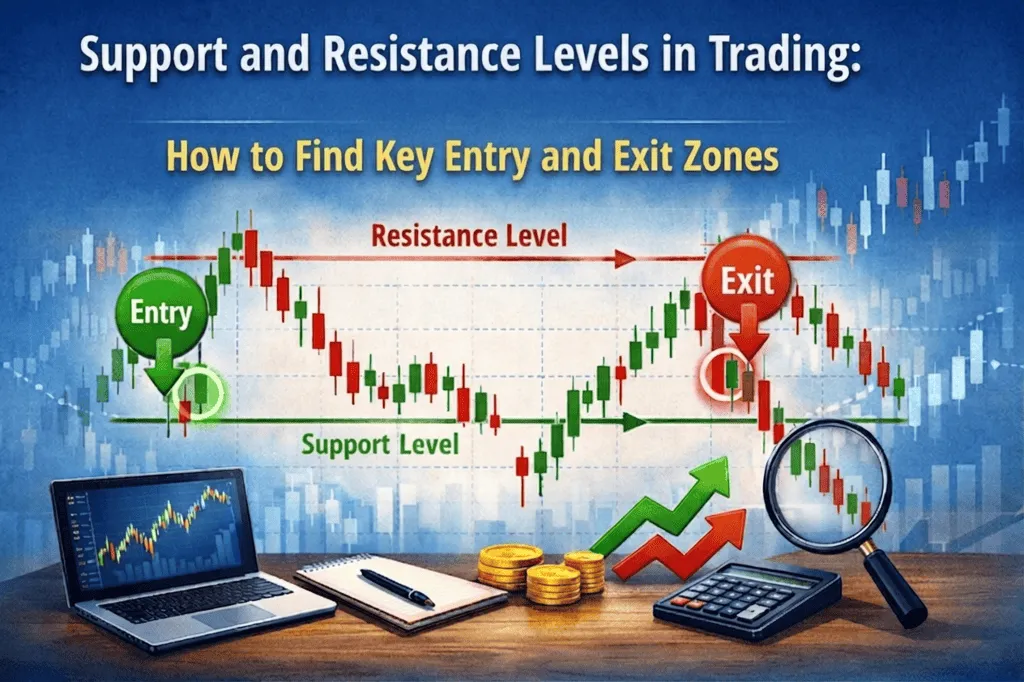
The stop-loss needs to sit where market structure breaks down — beyond a support level, beyond a local low, beyond a significant technical level. The distance from your entry price to the stop-loss is the basis for calculating position size. A mistake: setting your stop-loss “by eye,” or moving it after opening the trade.
Step 3. Calculate your position size.
The formula: Position Size = (Deposit × Risk%) / Distance to Stop-Loss. For example: a $10,000 deposit, 1% risk = $100, a 50-point distance to the stop-loss, a point value of $0.10 → 100 / (50 × 0.10) = 20 lots. A mistake: opening a maximum-size position with no regard for the actual risk.
Step 4. Assess your risk/reward ratio.
Before opening a position, define your take-profit. Potential profit should be at least twice as large as the possible loss. If your take-profit gives you a ratio below 1:2, it’s better to skip the trade. A mistake: entering a trade with no clear take-profit level, planning to “close by feel.”
Step 5. Set your daily loss limit.
Decide what total daily loss will make you stop trading. A standard benchmark is 3–5% of the deposit. Once you hit that mark, close the terminal. A mistake: continuing to trade “to win it back” — that leads to exponentially growing losses.
Step 6. Keep a trading journal.
Log every trade: the instrument, entry point, stop-loss, take-profit, reason for entry, outcome, and emotional state. After 50–100 trades, the journal will reveal statistics: which situations are profitable, and where you’re systematically losing. Without statistics, improving your results is impossible. A mistake: trading with no tracking or analysis of your own stats.
Step 7. Review your rules regularly.
Market conditions change: what worked in the crypto market in 2023 might deliver different results in 2026. Once a quarter, review your journal, revisit your stop-loss parameters, and reassess your risk ratio. A mistake: assuming a risk-management system, once configured, needs no updates.
Tools and Platforms for Risk Management: A Comparative Analysis
Controlling risk effectively depends not just on personal rules, but on the technical tools trading platforms offer. In 2026, most brokers and crypto exchanges offer built-in risk-management mechanisms, though their capabilities vary significantly.
| Platform / Tool | Market Type | Built-in Stop-Loss | Trailing Stop | Leverage Cap | Daily Loss Limit |
|---|---|---|---|---|---|
| MetaTrader 5 | Forex, CFD | Yes | Yes | Up to 1:500 | No (manual setup) |
| Binance Futures | Crypto futures | Yes | Yes | Up to 1:125 | No |
| Bybit | Crypto futures | Yes | Yes | Up to 1:100 | No |
| Interactive Brokers | Stocks, futures | Yes | Yes | Regulated by FINRA | Yes (PDT rule) |
| TradingView + broker | Any | Via broker | Via broker | Depends on broker | No |
MetaTrader 5 remains the gold standard for Forex traders: flexible order settings, trailing stops, and detailed statistics. Binance Futures and Bybit suit crypto trading, but demand caution around high leverage — it’s best to manually cap it at 5–10x. Interactive Brokers stands out for its built-in loss limits and strict regulation. TradingView is convenient for analysis, but its risk-management functions run through whichever broker is connected.
The takeaway: no platform automatically manages risk on a trader’s behalf. Tools only automate rule execution — you have to build the rules yourself.
Risks, Mistakes, and Pitfalls in Risk Management
Ignoring Gaps and Slippage
A stop-loss isn’t an absolute guarantee. During sharp market moves (news, market open), price can jump past your stop-loss level, and the position closes at a worse price. This is called slippage. On crypto markets, gaps are especially frequent during periods of high volatility. Trading liquid instruments and reducing position size around major news releases both help minimize this risk.
Excessive Leverage
Leverage amplifies both profit and losses. A trader using 1:50 leverage with 1% deposit risk is actually risking 50% on a 1% market move. Real catastrophe: in 2021-2022, thousands of retail traders blew their deposits on crypto futures precisely because of 20-100x leverage combined with no stop-loss. The rule: for beginners, leverage shouldn’t exceed 5-10x.
Averaging Down a Losing Position
Adding to a losing position “because the price is bound to come back” is one of the most destructive habits. It violates the principle of capital management and turns a small loss into a catastrophic one. Professional traders close losing positions at their stop-loss and don’t hold onto them out of emotional attachment.
No Statistics or Analysis
A trader who doesn’t keep a journal doesn’t know their real win/loss ratio. They trade “blind,” with no understanding of whether their trading system even works. Without statistics, spotting systematic mistakes is impossible — for example, that 80% of losses happen within the first two hours after the U.S. session opens.
Psychological Pressure and Rule Violations
The weakest link in any risk-management system is the trader themselves. Under the influence of fear, greed, or the urge to win back a loss, they break their own rules. Research shows most losing trades happen precisely during periods when a trader deviates from their predefined plan. The fix: automate stop-loss execution through the terminal, rather than relying on “manual closing.”
Statistics and Data: What the Numbers Say About Risk in Trading.
The Share of Traders Who Lose Money
According to EU regulators (ESMA) and independent research, 70% to 80% of retail CFD and Forex traders show losses over a 12-month period. In crypto futures markets, the picture is similar: according to Glassnode and CoinGlass estimates for 2024-2025, roughly 75% of positions with leverage above 10x close at a loss. These numbers aren’t a verdict — they’re a benchmark: most people lose not because of bad analysis, but because of a missing risk-management system.
The Impact of Stop-Losses on Trading Results
Statistics from prop trading firms show a clear correlation: traders who consistently use a stop-loss and maintain a risk/reward ratio of at least 1:2 show positive returns in 60-70% of cases over a 6-month horizon. Those trading with no stop-loss lose their account in 85% of cases over the same period.
Drawdown and Position Size
The math of recovering from a drawdown is nonlinear. Lose 50% of your deposit, and you need to earn 100% to get back to your starting amount. Lose 25%, and 33% will do. That’s exactly why risk control is critically important: small, regular losses under proper risk management let you preserve capital and give your strategy time to realize its statistical edge.
The Growth of Algo Trading and Its Impact on Risk
By 2026, algorithmic trading’s share of financial-market activity exceeds 60-70% of total volume. That means price moves have become sharper and less predictable for manual traders. Risk-management rules with clear stop-loss levels and position-size limits aren’t just useful anymore — they’re necessary for survival in the market.
Current Risk-Management Trends
Automating Risk Management Through AI Tools
In 2025-2026, a new generation of tools hit the market that use machine-learning algorithms to dynamically adjust position size and stop-loss levels. Services like 3Commas, Gunbot, and integrated solutions from major brokers analyze an asset’s volatility in real time and automatically adapt order parameters. This reduces the influence of the emotional factor — one of the leading causes of losses.
Tighter Leverage Regulation
Regulators in the EU, UK, and a number of Asian countries continued their policy of restricting leverage for retail clients through 2025-2026: a maximum of 1:30 for major currency pairs, and 1:2-1:5 for crypto. This trend protects beginner traders from catastrophic losses and effectively makes risk management a mandatory part of trading.
Expanding Prop Trading Requirements
Prop trading firms — companies that give traders capital to manage — have widely adopted strict risk-management rules as a condition of funding. A maximum daily drawdown of 5%, a maximum overall drawdown of 10%, and mandatory stop-losses are now standard requirements for getting a trading account. This is shaping a risk-management culture among the new generation of traders.
The Growth of Decentralized Derivatives (DeFi Futures)
Protocols like dYdX, Hyperliquid, and similar platforms grew their decentralized futures trading volume through 2025-2026. This opens new opportunities, but carries specific risks: smart contracts can contain vulnerabilities, and position liquidation happens automatically with no ability to “negotiate” with a broker. On decentralized platforms, risk-management rules need to be even stricter than on centralized ones.
Conclusion: Where to Start and What to Do Next

Risk management in trading isn’t a restriction on freedom — it’s the tool that lets you trade for the long haul. Three key takeaways: without a risk-management system, even a profitable strategy will eventually turn into a loss; position size, stop-loss, and the risk/reward ratio are the three pillars a stable result rests on; discipline in executing the rules matters more than the rules themselves.
For beginners: start with 0.5-1% risk per trade, trade with no leverage for your first three months, and keep a journal from day one. For traders with up to a year of experience: audit your statistics, calculate your real win/loss ratio, and revisit your stop-loss levels based on current market volatility. For experienced traders: study the Kelly criterion for optimizing position size, and test automated solutions for order management.
Keep up with new material on PropTradingRank.com — current trading-strategy breakdowns, market-analysis tools, and practical guides for traders of every level are published here.
Frequently Asked Questions
What should the risk per trade be for a beginner trader?
The optimal risk for beginners is 0.5-1% of the deposit per trade. With this approach, even 20 losses in a row won't wipe out the account — they'll give you time to adjust your strategy. It's worth increasing your risk to 2% only once you have confirmed statistics from your trading system — at least 100 trades.
What should you do if your stop-loss triggers too often?
A frequently triggered stop-loss is a signal not that the stop-loss is placed wrong, but that your entry point is poorly chosen. Revisit your entry logic: the stop-loss level should sit beyond significant market structure, not be placed "by eye." Tightening the stop-loss to reduce losses only increases how often it triggers.
Is a stop-loss mandatory when trading crypto?
A stop-loss matters especially in crypto markets because of their high volatility. Crypto assets can drop 20-40% within a few hours on bad news or liquidation cascades. Trading crypto with no stop-loss isn't a strategy — it's a bet that the market will come back. Sometimes it does, sometimes it doesn't.
How do you calculate the optimal risk/reward ratio?
The minimum acceptable ratio is 1:2 (risking $100 to make $200). With that math, only 34% of your trades need to be winners for trading to stay profitable overall. Aim for a 1:3 ratio or higher — that gives you a bigger margin of safety.
What is drawdown, and what level is considered critical?
Drawdown is the decline in your deposit from its peak value to its current level. A drawdown up to 10% is considered moderate and recovers under normal risk management. A drawdown of 25-30% calls for a strategy review. A drawdown above 50% is critical: mathematically, you'd need to double the account to recover, which is extremely difficult.
Should you change your risk-management rules for different market conditions?
Yes, adapting is necessary. During periods of high volatility (major news releases, macroeconomic events), it's worth reducing position size and widening your stop-loss. During periods of low activity and range-bound trading, risk also gets adjusted: within a narrow range, stop-losses get tighter. This isn't breaking the rules — it's sound capital management.
How does leverage affect risk management?
Leverage doesn't increase risk by itself — it increases the dollar value of each point of movement. A trader with a $1,000 deposit and 1:10 leverage controls a $10,000 position. A 1% market move against the position produces a $100 loss — already 10% of the deposit. That's exactly why the allowable position size shrinks proportionally as leverage rises.
How does discipline connect to risk management?
Discipline is a mandatory condition for any risk-management system to function. Rules are useless if they get broken under stress. Practical tools for maintaining discipline: automated orders instead of manual closing, a trading plan set before opening a position, and a pause in trading once you hit your daily loss limit.
Related Articles:












- What Risk Management Is and How It Works in Practice
- Core Approaches to Risk Management in Trading
- How to Build a Risk-Management System: A Step-by-Step Guide
- Tools and Platforms for Risk Management: A Comparative Analysis
- Risks, Mistakes, and Pitfalls in Risk Management
- Statistics and Data: What the Numbers Say About Risk in Trading.
- Current Risk-Management Trends
- Conclusion: Where to Start and What to Do Next

Top 10 Best Prop Firms
| # | Prop Firm | Rating | Assets | Profit Split | Funded Capital | Challenge Fee | Founded | Promo Code | Website |
|---|---|---|---|---|---|---|---|---|---|
|
1
|
4.9
|
Crypto, Stocks, Indices, Metals, Energy
|
Up to 90% | Up to $200,000 | From $79 | 2023 |
20% discount
RANK20
|
Visit Website | |
|
2
|
4.8
|
Crypto, Forex
|
Up to 90% | Up to $200,000 | From $99 | 2023 |
20% discount
RANK20
|
Visit Website | |
|
3
|
4.7
|
Prediction Markets, Polymarket
|
Up to 90% | Up to $50,000 | From $30 | 2026 |
25% discount
RANK25
|
Visit Website | |
|
4
|
4.7
|
Crypto, Forex, Other Assets
|
Up to 90% | Up to $200,000 | From $59 | 2024 |
10% discount
Follow the link
|
Visit Website | |
|
5
|
4.7
|
Crypto
|
Up to 90% | Up to $200,000 | From $59 | 2023 |
10% discount
Follow the link
|
Visit Website | |
|
6
|
4.6
|
Crypto, Forex, Stocks, Indices, Metals, Energy
|
80%–100% | Up to $200,000 | From $49 | 2026 |
30% discount
RANK30
|
Visit Website | |
|
7
|
4.6
|
Forex, Stocks, Indices, Metals
|
Up to 90% | Up to €300,000 | From €40 | 2023 |
30% discount
RANK30
|
Visit Website | |
|
8
|
4.5
|
Crypto, Forex, Indices, Metals
|
80%–100% | Up to $200,000 | From $89 | 2013 |
No Promo Code
|
Visit Website | |
|
9
|
4.5
|
Crypto, Forex
|
Up to 90% | Up to $200,000 | From €79 | 2015 |
No Promo Code
|
Visit Website | |
|
10
|
4.3
|
Crypto, Forex, Other Assets
|
60%–95% | Up to $200,000 | From $32 | 2024 |
20% discount
HELLO
|
Visit Website |