



Trading Psychology: What Qualities a Trader Needs for Success

Most beginner traders are convinced the key to consistent profit is the right strategy and technical analysis. They pore over charts, study indicators, and read books on trading systems. But the statistics are unforgiving: roughly 80% of retail traders lose money in Forex and crypto markets — and the reason usually isn’t the strategy, it’s what’s going on in their head. Trading psychology determines whether a trader survives in the market or joins the ranks of those who blow their deposit within a few months.
This article breaks down how decision-making psychology works in trading, which character traits separate a successful trader from a losing one, which psychological traps most often destroy even experienced market participants, and how to systematically work on yourself to trade with a clear head. This material is equally useful for beginners who just opened their first account and for experienced traders who feel their emotions are getting in the way of following their trading plan.

- How Psychology Shapes Decision-Making in Trading
- The Key Psychological Traits of a Successful Trader
- How to Build Psychological Resilience: A Step-by-Step Guide
- Trader Psychological Profiles: A Comparative Look at Different Approaches
- Psychological Traps That Keep Traders from Making Money
- Statistics and Data: What the Numbers Say About Trading Psychology
- Current Trends in Trading Psychology
- Conclusion: Where to Start Working on Your Trading Psychology
How Psychology Shapes Decision-Making in Trading
Trading the financial markets is a continuous stream of decisions made under uncertainty. Every time a trader clicks “buy” or “sell,” they trigger a whole cascade of psychological processes: assessing risk, weighing reward, fighting off fear and greed. That’s exactly where the trap lies: our brains aren’t evolutionarily built for trading a market.
Neuroscientists have found that the human brain activates the same regions when facing a loss as it does when facing physical danger. That means a $1,000 loss isn’t perceived as an abstract number — it’s perceived as a real threat. The brain wants to “escape” immediately — so the trader closes the position at a loss, even though the strategy called for holding it longer. Or, conversely, ignores the stop-loss, hoping for a reversal.
Brett Steenbarger — one of the leading psychologists in the trading world and author of “The Psychology of Trading: Tools and Techniques for Minding the Markets” — describes this mechanism through the concept of emotional patterns. In his observation, traders don’t just make mistakes: they repeat the same mistakes over and over, because they aren’t aware of their own patterns of success and failure. The point of the book is to help identify the thinking patterns that get in the way of sound decisions.
Here’s a practical example: a trader analyzes EUR/USD, sees a clear downtrend, opens a short — the right call. But an hour later, the position is down 50 pips on a correction. The strategy says: hold the position, the trend isn’t broken. The brain screams: close it, you’re losing money! The trader closes it — and two hours later watches price fall another 200 pips without them. That exact gap between what a trader knows and what they do is the whole field of trading psychology.
A separate layer of the problem is that intellectual and emotional reactions to the market operate on different timescales. Logical thinking is slow — it takes time to analyze. Emotional reaction is instant. In a volatile market, where a 3% move can happen in a second, decisions get made before the rational brain has a chance to kick in. Understanding this mechanism is the first step toward controlling your own actions in the market.
Traders can change the outcome if they start taking psychological preparation as seriously as technical analysis. This isn’t talk about “positive thinking” — it’s concrete work on reactions, behavior patterns, and a system of rules that removes emotional decisions from the trading process.
The Key Psychological Traits of a Successful Trader
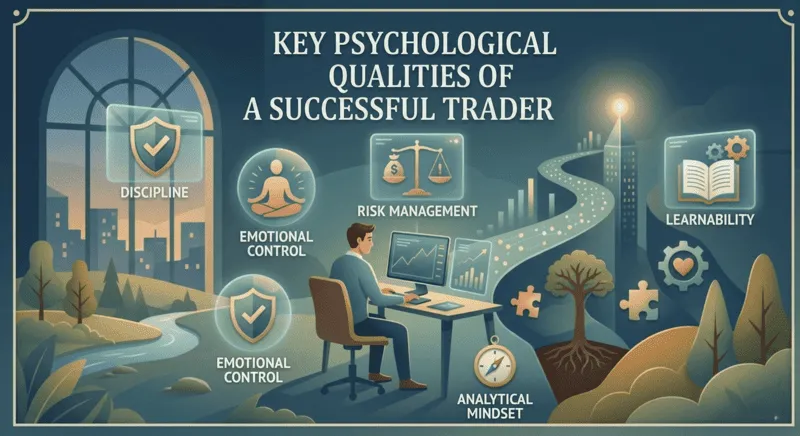
Over time, the market ruthlessly weeds out traders with the wrong psychological profile. Those who stay in the green year after year share a similar set of traits. They’re not necessarily smarter than everyone else — they’re just wired differently.
Discipline and Following the Rules
Discipline isn’t military drilling — it’s the ability to act according to plan even when emotion demands the opposite. A successful trader defines their entry and exit conditions, position size, and stop-loss in advance — and doesn’t deviate from those rules under the pull of impulse. Discipline is what turns a trading plan from a document into an actual protective mechanism. A telltale sign of undisciplined trading is “widening” a stop-loss. A trader sets a stop at $50, price approaches it, and they think: “I’ll wait a little longer, maybe it’ll reverse.” The stop shifts to $80, then $120 — and the position eventually closes with a loss three times bigger than planned. This isn’t a one-off mistake — it’s a systemic problem that only discipline solves.
Risk Management as a Worldview
Successful traders think in terms of risk and reward before they even look at potential profit. Before opening every trade, they ask: “How much am I willing to lose?” — and only then, “How much can I make?” That approach preserves capital even during rough patches, because a string of losing trades is normal, not a catastrophe. A rule many professional traders use: never risk more than 1–2% of your deposit on a single trade. With a $10,000 deposit, that means a maximum loss of $100–$200 per position. Even 10 losing trades in a row would leave the trader in the game with 80–85% of their capital. That’s a risk-management worldview, not just a number in a settings panel.
Emotional Resilience
The market generates an endless stream of stressful situations. A trader who gets knocked off balance by every move against their position burns out psychologically fast. Emotional resilience isn’t the absence of emotion — it’s the ability to keep emotions from steering decisions. After a big loss, a resilient trader analyzes the mistake and opens the next trade according to plan, rather than taking revenge on the market with a bigger lot.
Patience and the Ability to Wait
The most profitable trade is often the one a trader didn’t take. The ability to sit on the sidelines when the market isn’t giving a clear signal is a rare and valuable trait. Beginners suffer from “trading addiction”: they feel they need to trade every day, or they’re missing opportunities. Professionals understand that every trade with no clear justification is, statistically, a losing trade.
The Ability to Learn from Mistakes
Trading is a continuous process of learning through losses. Traders who treat a loss as a catastrophe leave the market. Traders who see feedback in a loss and adjust their behavior stay and grow. A trading journal, regular trade review, and honest self-reflection are the tools that turn mistakes into assets.
How to Build Psychological Resilience: A Step-by-Step Guide

A trader’s psychological preparation can’t happen in one evening. It’s a process built step by step, requiring regular practice. Below is a concrete roadmap for anyone ready to work on themselves systematically.
Step 1. Create a trading plan and treat it as law.
A trading plan is a document that spells out everything: conditions for entering a trade, stop-loss and take-profit levels, maximum risk per trade and per day, and a list of trading instruments and timeframes. Without a plan, a trader trades on emotion, not logic. It’s important to write the plan ahead of time, away from the market, with a cool head. A common mistake is adjusting the plan mid-trade, once you’re already in a position.
Step 2. Start keeping a trading journal.
The journal is a trader’s mirror. Log every trade: date, instrument, reason for entry, exit point, outcome, and — critically — your emotional state while trading. After 2–3 months, the picture becomes obvious: which days you trade best, which behavior patterns lead to losses, and when you shouldn’t trade at all. The journal helps identify your thinking patterns and work on them deliberately.
Step 3. Set “stop-trading” rules.
Define the conditions under which you stop trading for the day: three losing trades in a row, for example, or hitting your maximum daily loss. This mechanism protects against “revenge trading” — a situation where a trader tries to quickly win back losses by opening chaotic positions with an oversized lot. Behavioral finance research shows that after the stress of a loss, people systematically overestimate risk and make irrational decisions.
Step 4. Practice meditation and mindfulness techniques.
This sounds out of place for trading, but the largest hedge funds — including Ray Dalio’s Bridgewater — actively use mindfulness practices to manage trading teams. Ten to fifteen minutes of meditation before a trading session lowers background anxiety and improves concentration. This isn’t mysticism — it’s neuroscience: regular meditation literally reshapes the prefrontal cortex, the region responsible for decision-making and impulse control.
Step 5. Trade a size that doesn’t interfere with thinking.
One of the most common pieces of advice from experienced traders: cut your lot size in half. When the risk on a trade is too large relative to a trader’s psychological comfort level, emotion starts to dominate. The rule is simple: if you’re constantly staring at a position and feeling anxious while trading, your size is too big. A comfortable size lets you calmly wait for the situation to develop and stick to the plan.
Step 6. Study behavioral economics and psychology.
Books by Daniel Kahneman (“Thinking, Fast and Slow”), Brett Steenbarger (“The Psychology of Trading”), and Van Tharp (“Trade Your Way to Financial Freedom”) build an understanding of the mechanisms driving behavior in the market. This isn’t fiction — it’s applied tooling. Understanding why the brain works the way it does helps you manage yourself better.
Step 7. Review losses without self-criticism.
After a losing trade, ask yourself three questions: “Did I follow my plan?”, “If yes — that’s just statistics; if no — exactly where did I deviate, and why?”, and “What will I change next time?” Self-flagellation and emotional reactions like “I’m a failure” or “the market’s against me” are useless and harmful. Constructive analysis helps you move forward.
Trader Psychological Profiles: A Comparative Look at Different Approaches

Traders trade differently not just because of different strategies, but because of different psychological makeups. Understanding your own profile helps you choose a trading style that fits and know in advance which psychological challenges you’ll need to face.
| Profile | Trading Style | Strengths | Psychological Risks | What to Work On |
|---|---|---|---|---|
| Impulsive | Scalping, intraday | Fast reaction, flexibility | Trading with no plan, revenge trading | Discipline, stop-trading rules |
| Analytical | Swing, positional | Systematic thinking, patience | Analysis paralysis, missed entries | Decisiveness, trusting the system |
| Cautious | Long-term investing | Risk control | Misses profitable moves | Tolerance for short-term drawdowns |
| Thrill-seeking | High-frequency | High energy, drive | Addiction, overtrading, blown accounts | Risk management, mental hygiene |
| Systematic | Algorithmic or rules-based | Removes emotion from the process | Struggles adapting to changing markets | Flexibility, data interpretation |
No profile is inherently “good” or “bad.” Problems arise when the trading style clashes with the trader’s psychological makeup. An impulsive trader trying to trade positionally will close trades too early. An analytical trader scalping will suffer from analysis paralysis. Choose a style that fits your strengths — and work on your weaknesses.
Psychological Traps That Keep Traders from Making Money
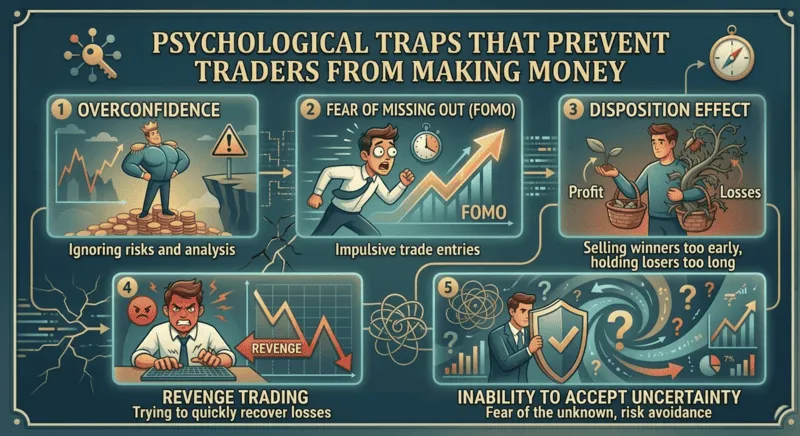
The market doesn’t forgive psychological weaknesses. Below are the most common traps that systematically drain money from a trading account, and ways to neutralize them.
1. Overconfidence (the Overconfidence Effect)
This is one of the sneakiest traps in trading. After a run of successful trades, a trader starts to believe they’ve “figured out the market,” increases position size, and ignores risk management. The “hot hand” effect — the belief that a winning streak will keep going — is well documented in behavioral economics. Prevention: log every trade in your journal and analyze whether profitable results come from the system or from luck.
2. Fear of Missing Out (FOMO)
A trader sees some asset up 30% in a day and jumps into the position right at the peak, ignoring every entry rule. FOMO is one of the biggest killers of trading capital in the crypto market. Bitcoin in 2021 was a textbook illustration: thousands of traders bought at the highs, swept up in the noise, and lost 60–70% of their investment within a few months. The cure: strict adherence to your trading strategy and understanding that there will always be new opportunities in the market.
3. The Disposition Effect: Locking In Profit Too Early
Traders sell profitable positions too soon and hold losing ones too long. Psychologists call this the “disposition effect” — it happens because the pain of a loss is roughly 2.5 times stronger than the pleasure of an equivalent gain (Kahneman and Tversky’s prospect theory). The practical fix: set your take-profit right when you open the trade, and don’t move it under the pull of emotion.
4. Revenge Trading
After a big loss, a trader immediately opens the next trade with an increased lot size to “win it back.” This almost always ends in additional losses. The market doesn’t know about your losses and doesn’t “owe” you anything back. The professional’s rule: after a loss that exceeds your daily limit, step away from trading until the next session.
5. Failing to Accept Uncertainty
Traders who can’t come to terms with the fact that any trade could lose money trade nervously and inconsistently. They look for a “safe” entry, wait for 100% certainty — and either miss the trade or enter too late. No trading strategy guarantees an outcome on any single trade. It offers a statistical edge over a large number of trades — and only accepting that fact allows you to trade systematically.
Statistics and Data: What the Numbers Say About Trading Psychology
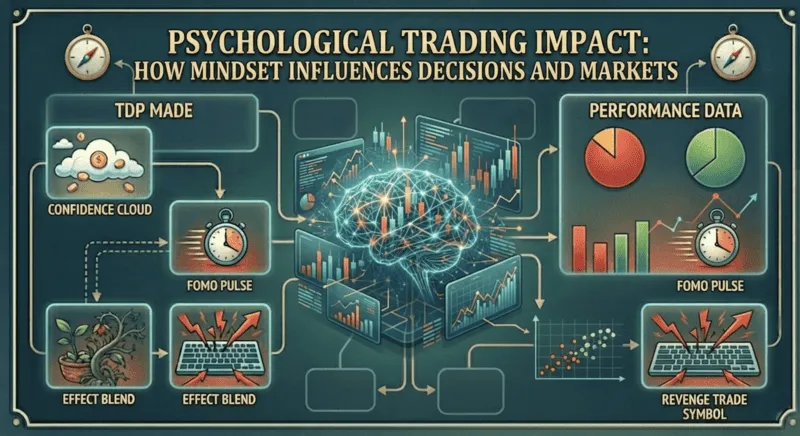
Who Loses Money, and Why
According to ESMA (the European Securities and Markets Authority), between 74% and 89% of retail traders lose money trading CFDs and Forex. Research by Brad Barber and Terrance Odean of the University of California found that active traders earn, on average, 6.5% less per year than passive investors — and the main driver of that underperformance is emotional decision-making: frequent position changes and poor timing.
The Effect of Discipline on Results
Research from the trading platform OANDA found that traders who use stop-losses on 100% of their trades show significantly better long-term results than those who trade with no protective orders — even when their stop-losses trigger more often. That’s not magic in the tool — it’s because a stop-loss is the physical embodiment of discipline and risk management.
Prop Trading and Psychological Standards
Prop trading firms, which provide traders with capital to work the market, have long concluded that technical analysis can be taught in months, but psychological resilience can’t be bought. That’s exactly why most prop firms build psychological mechanisms into their agreement terms: daily loss limits, maximum drawdowns, and bans on trading after a losing streak. These aren’t restrictions — they’re structural protection against emotional decisions.
Trading Crypto: Elevated Psychological Risk
The crypto market runs 24/7, is significantly more volatile than stocks and Forex, and the noise on social media — X/Twitter, Telegram, Reddit — massively amplifies emotional pressure. A 2022 Glassnode study found that more than 60% of retail Bitcoin investors sold their positions at the lows of the 2022 bear market — a textbook illustration of how fear destroys even a technically sound long-term strategy.
Current Trends in Trading Psychology
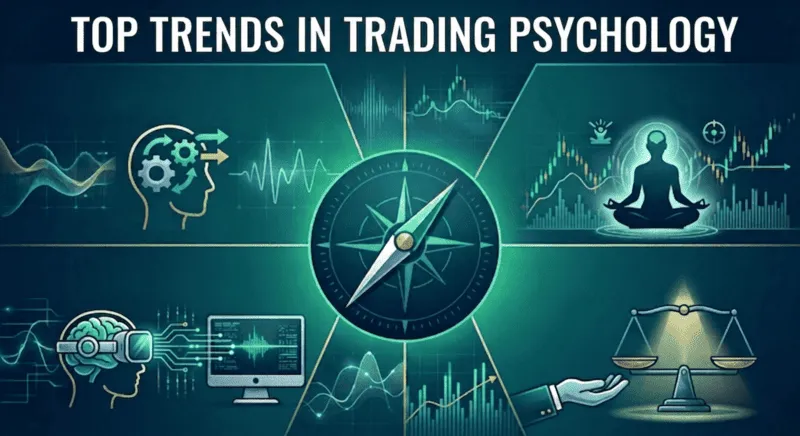
Neural Networks and Emotional Control
A new trend is using machine-learning algorithms to monitor a trader’s psychological state. A number of platforms are testing solutions that analyze trading-behavior patterns in real time and automatically restrict trading if they detect signs of emotional decision-making — for example, a sharp increase in trade frequency after a loss, or opening positions with no risk management. This matters because a trader under stress often doesn’t realize their decisions have become irrational.
Growing Interest in Behavioral Finance
Behavioral economics — the discipline studying why people make irrational financial decisions — went mainstream after Daniel Kahneman’s 2002 Nobel Prize. Today, behavioral-finance courses have found their way into curricula at the world’s top business schools, and trader training at prop firms increasingly includes blocks on decision-making psychology. Trading is no longer seen as a purely technical skill.
Psychological Testing for Prop Firm Applicants
Major prop trading organizations — including firms like Kingstree Trading — have started rolling out psychological tests as part of trader selection. These tests assess impulsivity, stress resilience, risk appetite, and reaction to losses. That means a psychological profile is becoming just as important a criterion as technical market knowledge.
Digital Detox and Trading Routines
Among experienced traders, the practice of clearly separating trading time from rest time is gaining popularity. Constant market-watching, typical of beginners, leads to chronic stress and emotional burnout. Professional traders increasingly talk about the importance of mental hygiene: limiting screen time outside trading sessions, physical exercise, sleep, and recovery as key factors in long-term performance.
Conclusion: Where to Start Working on Your Trading Psychology
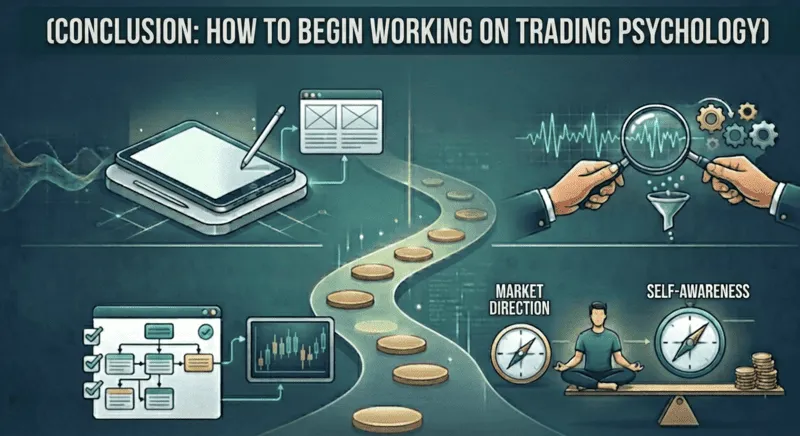
Trading psychology isn’t a soft science for people who can’t do math. It’s a concrete field of knowledge, and ignoring it costs traders real money. Emotions, cognitive biases, and psychological traps destroy strategically sound trades, force traders to break risk-management rules, and drag down even people with every technical skill needed for profitable trading into losing streaks.
The main takeaways from this article: a successful trader is, first and foremost, a disciplined person with a trading plan and a journal. Psychological resilience is built gradually, through reviewing mistakes and working on behavior patterns. Risk management isn’t optional — it’s the foundation. FOMO, overconfidence, and revenge trading are the three most costly psychological mistakes.
Recommendations for Different Types of Readers
- Beginners: start with a trading plan and follow it for 30 days with no exceptions. Trade the minimum lot size that doesn’t trigger anxiety. Keep a journal starting with your very first trade.
- Experienced traders with inconsistent results: review your last 50 trades for psychological mistakes. Introduce a stop-trading rule and stick to it for a week.
- Traders preparing for prop firms: remember that prop firms assess psychological resilience just as much as trading results. Loss limits aren’t punishment — they’re discipline training.
- Everyone: read books on behavioral finance. Trading psychology is a skill you build the same way you build technical-analysis skill.
Keep up with new material on PropTradingRank.com — you’ll find current strategy breakdowns, prop firm reviews, and practical guides on trading psychology here.
Frequently Asked Questions
Can you learn to trade with no psychological preparation?
Technically, yes, you can trade. But earning consistently with no psychological preparation is extremely difficult. Even a perfect strategy won't deliver results if a trader closes positions out of fear or breaks their stop-losses because they don't want to lock in a loss. Psychological preparation is what turns a strategy from theory into practice.
What is a trading journal, and why do you need one?
A trading journal is a document where a trader logs every trade: time, instrument, reason for entry, outcome, and emotional state. It's a tool for self-analysis: the journal reveals behavior patterns that lead to losses. Without a journal, a trader repeats the same mistakes over and over without realizing it.
How do you deal with the fear of losing money in trading?
Fear is a normal reaction. The problem isn't that it exists — it's the influence it has on your decisions. The best way to reduce that influence is to shrink your position size down to a level where a loss doesn't trigger anxiety, and work at that size until you've built stable patterns. As your confidence in the system grows, you can gradually increase position size.
What is FOMO in trading?
FOMO (Fear of Missing Out) is the fear of missing a market move. It shows up as a trader entering a trade impulsively upon seeing a sharp price move, with no regard for their strategy's rules. It's one of the most costly psychological mistakes, especially in the crypto market. The cure is strict adherence to your trading system and accepting that not every move needs to be caught.
How long does psychological preparation take for a trader?
It's a continuous process, not a course with a certificate. Basic skills — discipline, a trading plan, a journal — can be implemented immediately. But deep work on psychological patterns takes months, even years, of systematic practice. Experienced traders keep working on their psychology even after many years of profitable trading.
Why do traders lose money even when they know the right strategies?
Knowing and applying are different things. A trader might know they need to set a stop-loss, but in the moment of a real trade, emotion takes over. The gap between knowledge and action is a purely psychological problem. It's solved not by new strategies, but by systematic work on behavior: a trading plan, a journal, stop-trading rules, and mistake analysis.
Will Brett Steenbarger's book help a beginner trader?
"The Psychology of Trading: Tools and Techniques for Minding the Markets" is written for practicing traders who've already run into problems with discipline and emotional decisions. It'll be useful for beginners too — especially the sections on behavior patterns and self-analysis. The book's goal is to help you identify the thinking patterns that get in the way of trading by your system.
How do prop firms test traders' psychological resilience?
Prop firms use several mechanisms: they assess a candidate's behavior in simulators under pressure, analyze trading history for emotional patterns, and impose trial periods with strict loss limits. Some companies use psychological tests as part of the selection process. The ability to follow risk-management rules under real conditions is the key criterion.
Related Articles:











- How Psychology Shapes Decision-Making in Trading
- The Key Psychological Traits of a Successful Trader
- How to Build Psychological Resilience: A Step-by-Step Guide
- Trader Psychological Profiles: A Comparative Look at Different Approaches
- Psychological Traps That Keep Traders from Making Money
- Statistics and Data: What the Numbers Say About Trading Psychology
- Current Trends in Trading Psychology
- Conclusion: Where to Start Working on Your Trading Psychology

Top 10 Best Prop Firms
| # | Prop Firm | Rating | Assets | Profit Split | Funded Capital | Challenge Fee | Founded | Promo Code | Website |
|---|---|---|---|---|---|---|---|---|---|
|
1
|
4.9
|
Crypto, Stocks, Indices, Metals, Energy
|
Up to 90% | Up to $200,000 | From $79 | 2023 |
20% discount
RANK20
|
Visit Website | |
|
2
|
4.8
|
Crypto, Forex
|
Up to 90% | Up to $200,000 | From $99 | 2023 |
20% discount
RANK20
|
Visit Website | |
|
3
|
4.7
|
Prediction Markets, Polymarket
|
Up to 90% | Up to $50,000 | From $30 | 2026 |
25% discount
RANK25
|
Visit Website | |
|
4
|
4.7
|
Crypto, Forex, Other Assets
|
Up to 90% | Up to $200,000 | From $59 | 2024 |
10% discount
Follow the link
|
Visit Website | |
|
5
|
4.7
|
Crypto
|
Up to 90% | Up to $200,000 | From $59 | 2023 |
10% discount
Follow the link
|
Visit Website | |
|
6
|
4.6
|
Crypto, Forex, Stocks, Indices, Metals, Energy
|
80%–100% | Up to $200,000 | From $49 | 2026 |
30% discount
RANK30
|
Visit Website | |
|
7
|
4.6
|
Forex, Stocks, Indices, Metals
|
Up to 90% | Up to €300,000 | From €40 | 2023 |
30% discount
RANK30
|
Visit Website | |
|
8
|
4.5
|
Crypto, Forex, Indices, Metals
|
80%–100% | Up to $200,000 | From $89 | 2013 |
No Promo Code
|
Visit Website | |
|
9
|
4.5
|
Crypto, Forex
|
Up to 90% | Up to $200,000 | From €79 | 2015 |
No Promo Code
|
Visit Website | |
|
10
|
4.3
|
Crypto, Forex, Other Assets
|
60%–95% | Up to $200,000 | From $32 | 2024 |
20% discount
HELLO
|
Visit Website |