



News Trading: How to Trade the News Without Blowing Your Deposit

Every day, financial markets react to hundreds of events: inflation data releases, central bank interest-rate decisions, unemployment reports, geopolitical statements. News trading is one of the most profitable approaches in trading — and, at the same time, one of the most dangerous. In the moment major news breaks, the market can move as much in a few minutes as it normally does in an entire trading day. For some, that’s an opportunity to profit; for others, it’s a fast track to losing their deposit.
This article breaks down how the market reacts to news events, which news-trading strategies professional traders use, how to work with the economic calendar and pending orders, how to manage risk under sharp volatility, and which mistakes beginners make most often. This material suits both beginners and experienced participants in the Forex and crypto markets.

- How the Market Reacts to News: The Price-Movement Mechanism
- Core News-Trading Strategies
- How to Start Trading the News: A Step-by-Step Guide
- Economic Events and Their Market Impact: A Comparative Overview
- The Risks of News Trading: What Most Often Leads to Losses
- Statistics and Data: What the Numbers Say About News Trading
- Current Trends in News Trading
- Conclusion: How to Trade News and Protect Your Deposit
- Recommendations for Different Types of Readers
How the Market Reacts to News: The Price-Movement Mechanism
Financial markets are a constant clash between expectations and reality. An asset’s price reflects not just the current state of affairs, but what market participants expect in the future. That’s exactly why the market’s reaction to news often seems illogical: positive data can send price down, and negative data can send it up. This isn’t a paradox — it’s a pattern: the market trades on expectations, and news is the moment reality gets checked against forecasts.
Take a concrete example. The U.S. Federal Reserve publishes its interest-rate decision. Analysts forecast a 0.25% hike. If the Fed hikes by exactly 0.25%, the dollar might even weaken, because the market already “bought” that outcome in advance. If the rate rises 0.50%, the dollar spikes sharply. If it’s left unchanged, a sell-off follows. Price movement isn’t determined by the event itself, but by how far the actual data deviates from the forecast.
This mechanism is known as “buy the rumor, sell the fact.” Traders open positions ahead of time, based on expectations, and lock in profit the moment major news breaks, regardless of the actual outcome. Understanding this logic is the key to working with news in any financial market.
There are three phases of market reaction to economic events. The first is the waiting period: a few hours before the release, volatility drops, volume falls, and traders take a wait-and-see stance. The second is the initial reaction: in the first seconds after the data drops, the market moves sharply and unpredictably, often in both directions in quick succession. The third is consolidation: within 5–15 minutes, a stable trend forms that determines the direction of the move for hours afterward.
The so-called “two-minute rule” plays a special role here. The most dangerous moments for trading are the first 1–2 minutes after news breaks. Liquidity drops sharply, spreads widen 5–10x, and large market participants’ algorithmic systems generate chaotic price swings. Brokers may execute orders with significant slippage — meaning at a price different from what was requested. Entering the market at this stage means risking a loss before a genuine trend has even formed.
It’s also important to distinguish news by its impact on quotes. Macroeconomic data — GDP, inflation, unemployment, labor-market figures — move the market over hours and days. Central bank monetary policy — rate decisions, statements from regulator heads — creates longer-term trends. Political events — elections, sanctions, geopolitical tension — add uncertainty to the market. Understanding this hierarchy helps you prioritize when planning your trading day.
Core News-Trading Strategies
There are several working approaches to news trading. Each is built for a different experience level and risk profile.
Strategy 1. Pre-News Trading
The trader analyzes market expectations and opens a position ahead of time — 30–60 minutes before the data release. The goal: catch the move the market builds on expectations. This is a less risky option than trading at the moment of release, but it demands solid forecast analysis and an understanding of market sentiment. It suits experienced traders who know how to read the market and work with fundamental analysis.
Strategy 2. Breakout Trading with Pending Orders
Before the data release, the trader places two pending orders: one to buy above the current price, one to sell below it. When the news triggers a sharp move, one order triggers automatically. The other gets canceled immediately. This strategy lets you trade the news without guessing the direction. The main risk: slippage and false breakouts, when price triggers both orders in sequence.
Strategy 3. Post-News Trading
The trader waits for the initial volatility to settle and the market to form a clear direction — and only then enters the position. This is the most conservative approach: the trader gives up part of the move, but enters a clear trend with normal spreads and predictable order execution. It suits beginners just starting out with news trading.
Strategy 4. Trading Data Revisions
Many macroeconomic indicators — U.S. labor-market data, PMI indices, the trade balance — get published with a preliminary and a final value. The final figure often differs from the initial estimate, and that creates its own trading signal. Traders track the moment of revision and trade that move.
Strategy 5. News Trading in the Crypto Market
The crypto market reacts not just to macroeconomic data, but to regulatory decisions, exchange hacks, listings on major exchanges, and tweets from opinion leaders. Bitcoin and Ethereum can move 5–10% in an hour on a news-driven impulse. The market’s unique characteristics — running 24/7 with no unified news schedule — require constant monitoring of the information landscape through crypto-news aggregators.
How to Start Trading the News: A Step-by-Step Guide
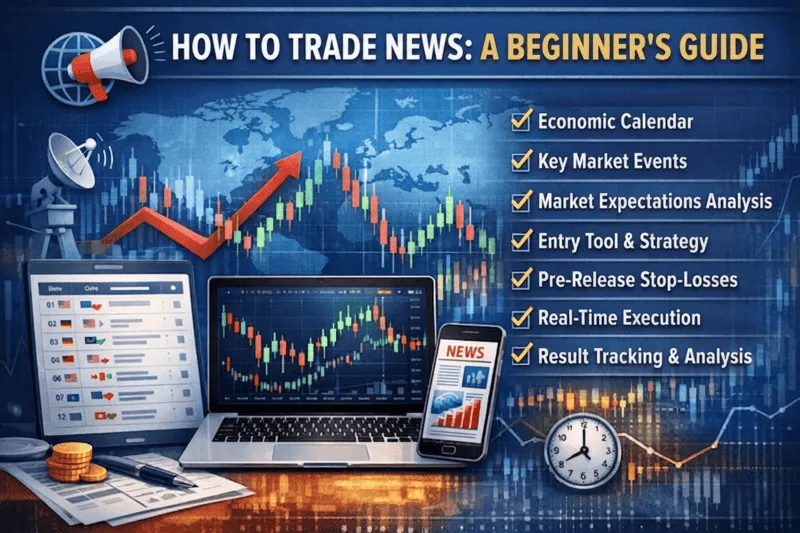
News trading requires preparation and a clear algorithm. Jumping chaotically into the market on every big headline isn’t a strategy — it’s a lottery. Below is a concrete plan for anyone who wants to trade news systematically.
Step 1. Master the economic calendar.
The economic calendar is the primary tool for any news trader. It shows the date and time of economic data releases, the previous reading, the current forecast, and the actual result. Reliable sources: Investing.com, Forex Factory, Bloomberg Economic Calendar. Flag events marked “high importance” — those are exactly what triggers moves measured in dozens of points. A common beginner mistake: trading every piece of news indiscriminately, including minor releases.
Step 2. Identify the week’s key events.
At the start of every trading week, build a list of priority news. For the Forex market, that’s primarily: Fed, ECB, and Bank of Japan rate decisions; Nonfarm Payrolls data (the first Friday of the month); CPI inflation figures; GDP from major economies. Log not just the date, but the consensus forecast too — the deviation from that forecast is exactly what drives the move.
Step 3. Analyze market expectations.
24–48 hours before a major data release, study what’s priced into the market: read broker analysis, check participant positioning through COT (Commitments of Traders) reports, analyze Fed-rate futures. The more precisely a trader understands market expectations, the better they can predict the reaction to the actual data.
Step 4. Choose your instrument and entry strategy.
Decide in advance: are you trading before the news, on the breakout with pending orders, or after the trend forms? Each approach has its own rule set. If you choose the pending-order strategy: place a buy stop 15–20 points above the current price and a sell stop 15–20 points below. The distance depends on the instrument and its typical volatility. A common mistake: placing orders too close to price — both trigger on the initial chaotic move.
Step 5. Set your stop-losses before the data release.
Stop-losses are mandatory when trading news — no exceptions. The market can move hundreds of points against a position within seconds. Place your stop-loss based on the instrument’s typical volatility range during news releases: for EUR/USD at the moment of NFP, that’s a minimum of 30–50 points. If your broker executes orders with slippage, factor that into your risk calculation.
Step 6. Monitor execution in real time.
At the moment the data drops, watch how your orders actually get filled. If your broker gives significant slippage (the execution price differs from the order price by more than 5–10 points on EUR/USD), that’s a signal that trading news with this broker isn’t worthwhile. Some brokers deliberately widen spreads to 10–20 points during major news releases — that’s legal, but it significantly hurts your results.
Step 7. Log your results and analyze.
After every news trade, log: forecast vs. actual data, the initial market reaction, the direction and size of the final move, your trade’s result, and the reasons for success or failure. Over time, you’ll build statistics on specific events: how the market has historically reacted to U.S. inflation data, how EUR/USD behaves at ECB meetings. That’s worth more than any news-trading course.
Economic Events and Their Market Impact: A Comparative Overview

Not all news affects financial markets equally. A trader needs a clear understanding of which events trigger significant price moves and which ones the market ignores. Below is a comparison table of key macroeconomic data ranked by market impact.
| Event | Market | Importance | Typical Move | Frequency |
|---|---|---|---|---|
| Fed Rate Decision | Forex, stocks, crypto | ★★★★★ | 50–200 pts EUR/USD | 8x a year |
| Nonfarm Payrolls (NFP) | Forex, stocks | ★★★★★ | 80–150 pts EUR/USD | Monthly |
| CPI Inflation Index | Forex, bonds | ★★★★☆ | 40–100 pts EUR/USD | Monthly |
| GDP (First Estimate) | Forex, stocks | ★★★★☆ | 30–80 pts EUR/USD | Quarterly |
| ECB Meeting / Press Conference | EUR pairs, bonds | ★★★★★ | 60–180 pts EUR/USD | 8x a year |
| PMI Business Activity Index | Forex | ★★★☆☆ | 20–50 pts EUR/USD | Monthly |
Five-star importance events are the priority for a news trader. Central bank decisions and U.S. labor-market data consistently generate moves measured in the hundreds of points. PMI and trade-balance data give weaker signals and are better suited for trading within an already-established trend rather than pure news trading.
For the crypto market, additional attention goes to: SEC decisions on Bitcoin ETFs, regulator statements on the status of crypto assets, major exchange hacks, and liquidation data from derivatives platforms. These events don’t appear on a standard economic calendar, but they influence Bitcoin’s and Ethereum’s price just as much as macroeconomics does.
The Risks of News Trading: What Most Often Leads to Losses
News trading draws people in with the promise of fast profit, but it hides several serious traps. Ignoring these risks is the main reason beginners blow their deposit specifically on news events.
1. Slippage
The moment major news breaks, market liquidity drops sharply. The broker can’t fill an order at the requested price — so it fills at the next available one. The gap between the requested and actual price is slippage. During an NFP release, slippage on EUR/USD at market-maker brokers can run 10–30 points. How to minimize it: choose brokers using NDD (No Dealing Desk) technology and trade on ECN accounts, which give direct access to interbank liquidity.
2. False Breakouts and Chart “Spikes”
Right after the data drops, price often makes a sharp move in one direction that fully reverses almost immediately. These chart “spikes” are the result of algorithmic systems fighting it out in the first seconds after release. A trader who opened a position on the initial move takes a loss when price returns to its starting level. The rule: don’t trade the first 1–2 minutes after news breaks.
3. Widening Spreads
Many brokers — especially market makers — widen spreads 5–15x the moment major news breaks. A EUR/USD spread that’s normally 0.5–1 pip can jump to 5–15 pips. This makes trading extremely unprofitable: even if price moves in your favor, the wide spread eats into your profit. Before trading major news, check how your broker’s spread has historically behaved.
4. Emotional Decisions Under Event Pressure
News trading is stressful. The market moves fast, your balance changes by the second, and decision time is minimal. Under these conditions, a trader with unstable psychology makes impulsive decisions: entering with no plan, moving stop-losses, doubling a position at a loss. A real-world example: during the March 2023 NFP release, EUR/USD moved 80 points in 30 seconds, then reversed 60 points. Traders who bought at the peak of the first move with no stop took a loss in the very move that was supposed to make them money.
5. Trading Illiquid Instruments on News
The less liquid an instrument, the harder slippage and widened spreads hit it. Trading exotic currency pairs — TRY, ZAR, MXN — or illiquid altcoins during a U.S. data release means knowingly taking on uncontrolled risk. For news trading, stick to highly liquid instruments: EUR/USD, GBP/USD, USD/JPY, the S&P 500, Bitcoin (BTC/USDT on major exchanges).
Statistics and Data: What the Numbers Say About News Trading

Trading Volume at the Moment Key Data Drops
The Nonfarm Payrolls release is one of the most anticipated events for the currency market. According to CMC Markets research, within the 15-minute window around the NFP release, EUR/USD trading volume rises 3–5x compared to a normal trading period. A similar effect shows up around central bank data releases: GBP/USD trading volume on the day of a Bank of England meeting has historically exceeded the average daily volume by 40–70%.
Statistics on Price Moves at Key Events
Based on historical data from 2018–2024, the average EUR/USD move within an hour of an NFP release was 75–120 points. Fed decisions produced an average move of 80–160 points in the first 30 minutes. U.S. CPI releases in 2022–2023 — during the active fight against inflation — regularly triggered moves of 100–200 points within 30 minutes. That’s equivalent to the daily range of several ordinary trading sessions.
News and the Crypto Market
The crypto market has shown an amplified reaction to macroeconomic data — especially since 2020, when Bitcoin started correlating with U.S. stock indices. According to CryptoCompare, on days when U.S. CPI data was released in 2022–2023, intraday BTC/USD volatility exceeded the average daily level by 2–3x. Regulatory events — like the SEC’s decision on Bitcoin ETF applications in January 2024 — triggered a 15% move in BTC within a few hours.
The Impact on Trader Results
Research into retail trader behavior on Forex platforms found that traders who actively trade during major news releases show, on average, worse results than those who avoid trading during those periods. The reason isn’t a lack of movement — it’s poor handling of slippage, spreads, and position management under high volatility. Skillful news trading requires specialized preparation and a clear algorithm.
Current Trends in News Trading
AI-Powered News Analytics
Large institutional traders have long used text-analysis algorithms to instantly parse news publications and automatically open positions. In 2024–2025, these tools became accessible to retail traders through specialized platforms: Trade Ideas, Accern, and Bloomberg Terminal with AI features. These systems scan the news flow in real time, gauge sentiment, and generate trading signals. This doesn’t eliminate the need to understand the market, but it significantly speeds up information processing.
Geopolitics as a New Source of Volatility
Since 2022, geopolitical events — sanctions packages, escalating conflicts, shifts in trade policy — have become a regular source of market volatility. Oil, gold, defense stocks, and emerging-market currencies react more sharply to political news than to standard macroeconomic data. Traders working with these instruments now monitor not just the economic calendar, but Bloomberg, Reuters, and AP news feeds around the clock.
Growing Importance of Central Bank Commentary
The market is increasingly reacting not to the rate decision itself, but to the wording of press conferences and public remarks from Fed, ECB, and Bank of Japan leadership. In 2023–2024, EUR/USD often moved more on ECB President Christine Lagarde’s press conference than on the preceding rate decision itself. Traders have learned to read “hawkish” and “dovish” signals in regulator rhetoric as a standalone trading signal.
Trading Crypto on Regulatory News
The launch of spot Bitcoin ETFs in the U.S. in January 2024 created a new category of drivers for the crypto market. Now Bitcoin and Ethereum are influenced not just by technological events (halvings, protocol upgrades), but by regulatory decisions from the SEC, CFTC, and the EU’s MiCA regulation. For traders, that means an expanded news calendar: crypto assets now need monitoring not just through crypto media, but through traditional financial outlets too.
Conclusion: How to Trade News and Protect Your Deposit

News trading isn’t for anyone looking for easy money with no knowledge behind it. It’s a distinct discipline within trading that demands an understanding of macroeconomics, the ability to work with the economic calendar, a clear algorithm, and iron discipline in risk management. Most traders who lose money trading news don’t do so because the market is unpredictable — they do it because they act with no plan during the most intense moment of the trading session.
The key principles that separate profitable news trading from blowing your deposit: always set stop-losses before the data release; don’t trade the first 60–120 seconds after news breaks; work only with highly liquid instruments; factor slippage and widening spreads into your risk calculation; only trade high-importance events on the economic calendar.
Recommendations for Different Types of Readers
- Beginners: start by watching the market during an NFP release with no real positions. Log how EUR/USD moves in the first 5–15 minutes. After 2–3 months of observation, move to trading a small lot once the market has stabilized.
- Experienced traders: test the pending-order strategy on a demo account across the next 10 NFP releases. Gather slippage statistics from your broker and compare against alternatives.
- Forex traders: focus on 3–4 key events a month — the Fed, NFP, U.S. CPI — instead of trading every release that comes along. Quality beats quantity.
- Crypto traders: add SEC and CFTC regulatory news to your monitoring list alongside on-chain data. In 2024–2025, the regulatory factor influences Bitcoin just as much as technical levels.
Keep up with current trading-event breakdowns and strategy updates on PropTradingRank.com — practical material for traders at every level is published there.
Frequently Asked Questions
Which news has the biggest impact on the Forex market?
The biggest impact on the currency market comes from: Fed interest-rate decisions, Nonfarm Payrolls (NFP) data, U.S. CPI inflation figures, ECB and Bank of Japan meetings, and the first estimate of U.S. GDP. These events trigger moves of 50 to 200 points on major currency pairs. All of them are flagged on the economic calendar as "high importance" (red on Forex Factory).
Can you trade news with no experience?
Trading at the moment major data drops is one of the hardest forms of trading. Without understanding the market's reaction mechanism, handling slippage, and having a clear algorithm, a beginner is nearly guaranteed to take losses. The recommended path: first watch the market during news releases with no positions, then practice on a demo account, and only move to real trades after 2–3 months of deliberate practice.
What are pending orders, and how do you use them for news trading?
A pending order is an instruction to your broker to open a position once price reaches a specific level. A buy stop sits above the current price (triggers on a rise), a sell stop sits below it (triggers on a drop). The "double pending order" strategy lets you automatically enter the market on a sharp move in either direction, with no need to guess the direction. The key condition: once one order triggers, cancel the other immediately.
Why does the market sometimes move against the expected direction after news?
This is a consequence of the "buy the rumor, sell the fact" principle. The market prices in expected data ahead of time. When the actual figures match the forecast or come in only slightly better, some participants lock in profit on positions opened before the event — and price falls. The move is driven not by the absolute value of the data, but by its deviation from the consensus forecast.
How do you choose a broker for news trading?
For news trading, what matters is: minimal slippage (look for brokers using ECN/STP technology), fixed or floating spreads with no sharp widening during news, and fast order execution (no more than 50–100 ms). Check trader reviews on forums like Forex Peace Army — they often publish real slippage data for specific brokers during NFP releases.
Does news affect the crypto market the same way it affects Forex?
The crypto market reacts to macroeconomic data more strongly every year — especially Bitcoin and Ethereum. Since 2020, BTC's correlation with the S&P 500 has grown significantly. On top of that, the crypto market reacts to regulatory events (SEC, CFTC decisions), technological news (hard forks, network upgrades), and large-player activity (moving big volumes onto exchanges). That makes the news landscape broader and requires monitoring a wider range of sources.
Do you need technical analysis when trading news?
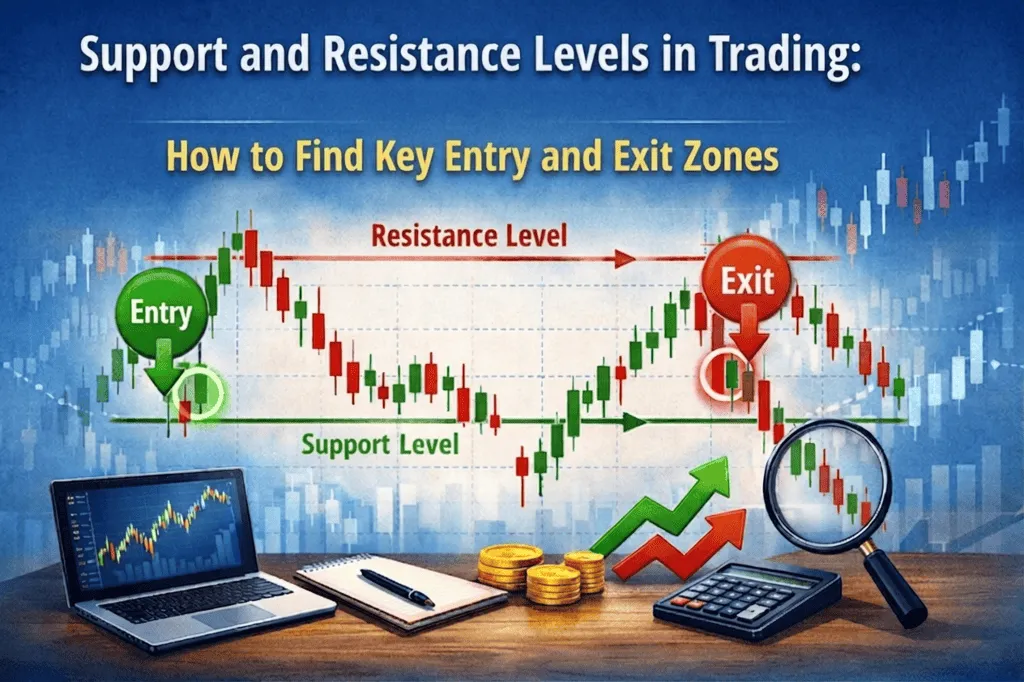
Technical and fundamental analysis don't compete — they complement each other. After the data drops, the market moves within key technical support and resistance levels. A trader who understands both the fundamental context (data better/worse than expected) and the technical levels (where price could realistically go) makes more precise decisions than someone relying on just one of the two.
What should you do if your stop-loss didn't trigger correctly due to slippage?
This is a real problem in news trading. If the actual stop-execution price is significantly worse than what you placed, contact your broker and request an explanation. If it keeps happening, consider switching brokers or moving to guaranteed stop-losses (some brokers offer these for an extra fee). A guaranteed stop executes strictly at the specified price, regardless of volatility.
Related Articles:











- How the Market Reacts to News: The Price-Movement Mechanism
- Core News-Trading Strategies
- How to Start Trading the News: A Step-by-Step Guide
- Economic Events and Their Market Impact: A Comparative Overview
- The Risks of News Trading: What Most Often Leads to Losses
- Statistics and Data: What the Numbers Say About News Trading
- Current Trends in News Trading
- Conclusion: How to Trade News and Protect Your Deposit
- Recommendations for Different Types of Readers

Top 10 Best Prop Firms
| # | Prop Firm | Rating | Assets | Profit Split | Funded Capital | Challenge Fee | Founded | Promo Code | Website |
|---|---|---|---|---|---|---|---|---|---|
|
1
|
4.9
|
Crypto, Stocks, Indices, Metals, Energy
|
Up to 90% | Up to $200,000 | From $79 | 2023 |
20% discount
RANK20
|
Visit Website | |
|
2
|
4.8
|
Crypto, Forex
|
Up to 90% | Up to $200,000 | From $99 | 2023 |
20% discount
RANK20
|
Visit Website | |
|
3
|
4.7
|
Prediction Markets, Polymarket
|
Up to 90% | Up to $50,000 | From $30 | 2026 |
25% discount
RANK25
|
Visit Website | |
|
4
|
4.7
|
Crypto, Forex, Other Assets
|
Up to 90% | Up to $200,000 | From $59 | 2024 |
10% discount
Follow the link
|
Visit Website | |
|
5
|
4.7
|
Crypto
|
Up to 90% | Up to $200,000 | From $59 | 2023 |
10% discount
Follow the link
|
Visit Website | |
|
6
|
4.6
|
Crypto, Forex, Stocks, Indices, Metals, Energy
|
80%–100% | Up to $200,000 | From $49 | 2026 |
30% discount
RANK30
|
Visit Website | |
|
7
|
4.6
|
Forex, Stocks, Indices, Metals
|
Up to 90% | Up to €300,000 | From €40 | 2023 |
30% discount
RANK30
|
Visit Website | |
|
8
|
4.5
|
Crypto, Forex, Indices, Metals
|
80%–100% | Up to $200,000 | From $89 | 2013 |
No Promo Code
|
Visit Website | |
|
9
|
4.5
|
Crypto, Forex
|
Up to 90% | Up to $200,000 | From €79 | 2015 |
No Promo Code
|
Visit Website | |
|
10
|
4.3
|
Crypto, Forex, Other Assets
|
60%–95% | Up to $200,000 | From $32 | 2024 |
20% discount
HELLO
|
Visit Website |